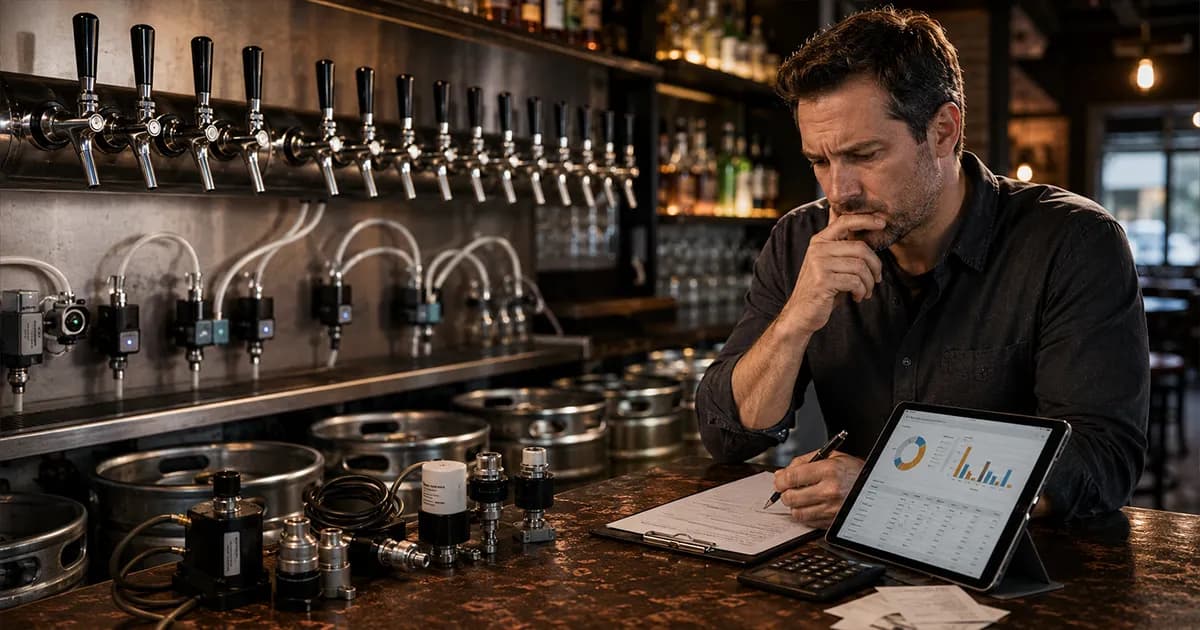
Draft beer monitoring hardware, flow meters installed directly on your tap lines, has been sold to bar owners as a passive, set-it-and-forget-it solution to keg loss. Pour something. A sensor counts it, and a dashboard tells you how many ounces left the tap. On paper, it sounds complete. In practice, there are two problems most people do not find out about until after the hardware is installed: the real cost, and how little of your bar's inventory it actually covers.
This article breaks down the full first-year cost of hardware-based draft monitoring, explains the coverage gap it leaves open for spirits and wine, and makes the case for why most bars, including tap-heavy ones, get better overall loss protection from a software-only inventory system.
Draft systems have their own maintenance and measurement realities. The Brewers Association's Draught Beer Quality Manual is the strongest non-competitor reference here because it covers draft system components, gas balance, sanitation, pouring, and line cleaning for retailers and brewers.
How Draft Beer Hardware Monitoring Works
Hardware-based draft monitoring systems, of which Bevchek is the most commonly cited example, work by installing small flow meters directly into each tap line, between the keg coupler and the tap shank. When beer flows through the line, the meter counts it in ounces. That data is transmitted wirelessly to a central hub, which syncs to a cloud dashboard showing you how much poured from each tap.
The system then compares what the flow meter recorded against what your POS logged as sold, giving you a variance figure per tap. If your POS says you sold 20 pints of IPA but your flow meter says 23 pints actually flowed, you have a three-pint discrepancy. That might be over-pouring, foam waste, comps not logged, or a meter calibration drift, but you have a number to investigate.
That core functionality is real and it works, for draft beer. The system gives you granular pour data that count-based inventory tracking cannot match. Where things get complicated is in what it costs and what it does not cover.
The Real Cost Breakdown
Hardware monitoring systems are rarely presented with total cost transparency at the point of sale. The monthly subscription fee gets the headline; the hardware bill arrives separately. Here is a realistic breakdown for a typical installation:
- 1Installation fee: typically $800 to $1,200 for a professional installation, covering the initial hardware setup, line threading, and calibration.
- 2Per-tap hardware cost: approximately $80 to $120 per tap for the flow meter unit. A 20-tap bar adds $1,600 to $2,400 to the hardware bill.
- 3Monthly service fee: approximately $150 to $200 per month depending on the number of taps and reporting tier.
- 4Maintenance and recalibration: flow meters require periodic calibration and occasional replacement. Budget $200 to $400 annually for a moderately sized tap system.
- 5Technician call-outs: if a meter malfunctions or a line needs reconfiguration, service calls typically run $100 to $200 per visit.
For a 20-tap bar using a system like Bevchek, the first-year total runs approximately $4,800 to $6,000: $2,800 to $3,600 in upfront hardware and installation plus $1,800 to $2,400 in annual service fees. Year two and beyond drops to the service fee plus maintenance, but the upfront investment does not come back if you decide the system is not working for you.
The Coverage Gap: Draft Beer is Not Where Most Bars Lose Money
This is the part of the hardware pitch that tends not to get mentioned explicitly: flow meters monitor liquid flowing through a tap line. That means kegs only. Spirits, wine, bottled beer, cocktail batches, food, and supplies are completely outside the system. The dashboard shows you nothing about your back bar.
For a craft beer taproom where draft beer accounts for 90 percent of revenue, that coverage is meaningful. For a full-service bar or restaurant bar where cocktails, spirits, and wine make up 60 to 80 percent of revenue, hardware monitoring is covering the minority of your inventory while the majority goes untracked.
Industry data consistently places spirits and cocktails as the highest-margin and highest-theft-risk category in most bar operations. Bartender theft methods disproportionately target spirits, bottle swaps, free pours for regulars, under-ringing on premium spirits, and cash skimming on spirit-forward cocktails. None of these show up in a draft monitoring system because none of them involve a keg tap.
The practical result is that a bar spending $5,000 in year one on draft hardware has a sophisticated monitoring system for one product category, and nothing for the rest. Meanwhile, a 750ml bottle of Patron Silver worth $45 retail can walk out the back door or disappear through consistent over-pours without generating a single alert.
The Hardware Maintenance Reality
Physical sensors in a working bar environment are not static. Draft lines get cleaned, pulled, repositioned, and recoupled regularly. Flow meters need to be removed and reinstalled during line cleanings, which introduces calibration variation. Vibration from nearby equipment can affect meter accuracy over time. Foam, unavoidable in draft service, creates measurement noise that even well-calibrated systems handle imperfectly.
The result is that the accuracy of a hardware system degrades between calibration events. A meter that was accurate at installation may drift by three to five percent over a busy quarter, which on a high-volume tap amounts to meaningful uncredited pour volume, variance that looks like theft but is actually sensor drift. Diagnosing that correctly requires knowing the calibration history of each individual meter, which most operators do not track.
Software-only inventory systems do not have this problem. There is no physical component to calibrate. A count is a count. A human measured the level in a container and logged it. The math that follows is deterministic: if the POS says you sold X, and your count shows Y consumed, the gap is Z. No sensor drift, no maintenance schedule, no service call.
What Software-Only Inventory Tracking Looks Like for Draft Beer
Software-based inventory systems track keg inventory through count-based measurement. You weigh kegs using a scale, measure the remaining volume with a ruler or pressure gauge, or estimate level by feel at each count cycle. This is less granular than per-ounce flow meter data, but it covers the same fundamental question: how much beer left this keg between counts, and how does that compare to what the POS says we sold? The operating workflow behind that question is covered in our draft beer shrinkage guide.
The key advantage is that a software system does not limit its coverage to the tap lines. The same count cycle that measures keg levels also counts your bourbon bottles, your wine inventory, your batch cocktail containers, and your supplies. Every product category is included, and every variance calculation is run against POS sales data automatically, not estimated from a hardware sensor.
For the bar inventory variance math to work, you need accurate counts and accurate sales data. Software systems handle both, counts through a mobile counting interface, sales through a POS integration that syncs automatically. Hardware systems handle one piece of it (draft pour volume) very well, and the rest not at all.
Who Actually Benefits from Hardware Monitoring
Hardware draft monitoring is a legitimate tool for a specific type of operation. If your bar is a dedicated taproom where draft beer is the entire business, no cocktails, minimal spirits, draft accounting for 90 percent of your revenue, then flow meter data gives you a level of draft accountability that count-based methods cannot fully replicate. Real-time pour data, line-by-line accuracy, and over-pour detection down to the ounce are real advantages for that use case.
For full-service bars, restaurant bars, hotel bars, cocktail bars, and any operation where spirits make up a significant portion of revenue, the hardware investment covers a fraction of the inventory risk while leaving the majority unaddressed. The ROI math rarely works out, especially when you factor in the upfront cost, ongoing maintenance, and the complete absence of spirits and wine coverage.
The honest question to ask is: where is my bar actually losing money? For most operations, the answer involves spirits, cocktail over-pours, and untracked waste across the full product mix, not keg tap variance. Deploying a $5,000 hardware system to address a fraction of that risk while leaving the rest uncovered is a significant investment misaligned with where the problem actually lives.
A Software-Only Alternative: BarGuard vs Bevchek
BarGuard is a software-only bar inventory system that covers every product in your bar, draft beer, spirits, wine, bottled beer, food, and supplies, through a mobile counting app that connects directly to Toast, Square, Clover, and Focus POS. There is no hardware to install, no installation fee, and no per-tap cost. Setup takes under 30 minutes.
BarGuard's Professional plan is $249 per month and includes everything in Essential, plus multi-user logins, vendor management, and full P&L reporting. For a 20-tap bar comparison: BarGuard year one costs $2,988. Bevchek year one costs $4,800 to $6,000, for draft coverage only. BarGuard covers everything Bevchek does not, costs less in total, and requires zero hardware.
For a complete feature-by-feature comparison, see the BarGuard vs Bevchek comparison. The short version is that unless your operation is a draft-only taproom with no meaningful spirits revenue, software-only inventory management is more cost-effective, more comprehensive, and simpler to maintain than hardware-based monitoring.
BarGuard Catches What You Can't See
Connect your POS, count your inventory, and let BarGuard show you exactly where the gaps are, automatically, every week.