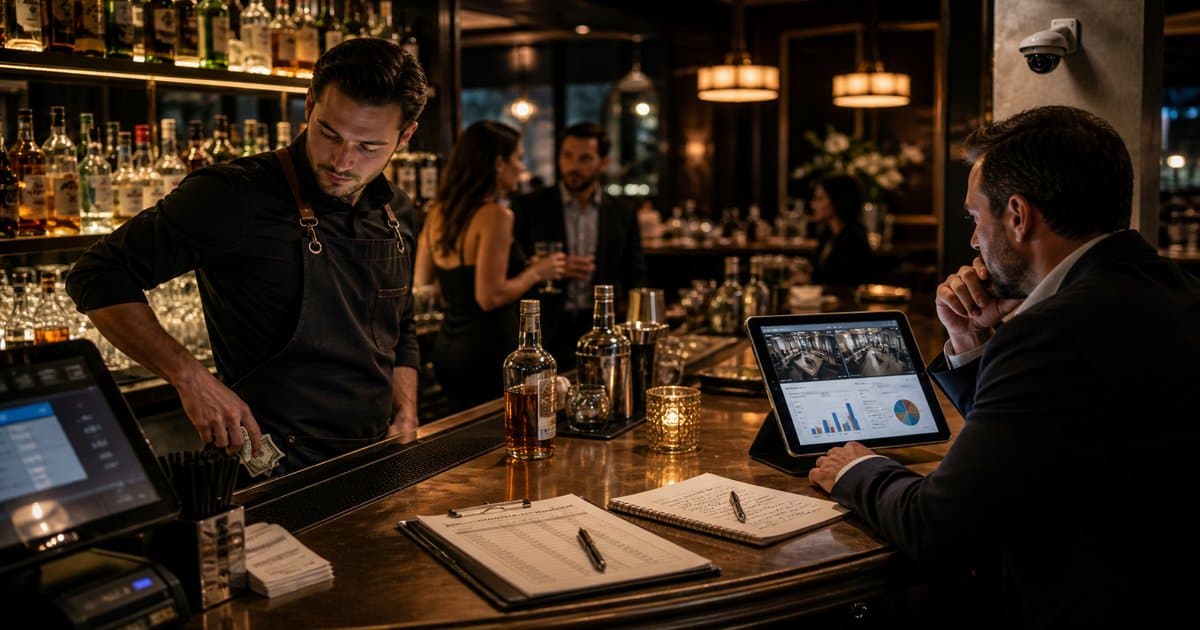
Common bartender theft methods range from obvious cash grabs to subtle patterns that take months to surface, and most bars are exposed to several at once. Industry research consistently places internal theft at 35 to 40 percent of total bar shrinkage. The problem is rarely one person doing one thing. It is more often multiple employees each exploiting a different gap in your controls, which is why ownership usually does not connect the dots until the loss has already compounded. Understanding the specific methods, and what each one looks like in your inventory variance data is the first step to catching it.
This kind of article should be used as an investigation framework, not a substitute for policy or legal guidance. For broader occupational fraud context, see the ACFE Report to the Nations; for tipped-employee wage and tip rules, use the U.S. Department of Labor's FLSA tipped employee fact sheet.
Why Bartender Theft Is So Hard to Catch Without Tracking
Most bartender theft works because the individual transactions are too small to stand out. A drink not rung up is a $10 or $12 discrepancy. A slightly short cash drawer is easy to attribute to a counting mistake. A quarter ounce of over-pour per cocktail is invisible without recipe-level data. The methods on this list succeed not because they are clever but because no one is running the math to catch them, and bartenders know it. Add to that the social dynamics of bar ownership, where confrontation can torch team morale and create legal exposure, and most managers end up looking the other way rather than building the case.
The fix is not cameras or spot checks. It is variance data. When you track expected usage against actual usage by item, by shift, and by employee, each theft method produces a distinct fingerprint that shows up in your numbers before it shows up in your gut. That is the approach covered throughout this guide.
The 15 Most Common Bartender Theft Methods
Some of these methods are well-known. Others fly under the radar precisely because they look like ordinary bar operations. All of them show up in inventory data if you know what pattern to look for.
1. Cash Skimming
Cash skimming is the simplest and oldest method: a customer pays for drinks in cash. The bartender enters fewer items into the POS, or nothing at all, and pockets the difference. No void needed, no refund trail, no obvious sign, just a cash drawer that consistently runs light on specific shifts. The tell in your data: high product depletion against lower-than-expected cash sales on those shifts. The usage pattern looks normal; the revenue does not match it.
2. Free Drinks for Tips (Sweethearting)
Sweethearting is the practice of pouring drinks for friends, regulars, or anyone the bartender wants to impress, with no transaction attached. The product leaves the bar, the cash never arrives, and the bartender earns social capital and often larger tips from other customers who notice the generosity. Unlike cash skimming, sweethearting leaves no cash trail at all. The variance signal: product usage on high-volume spirits climbs on nights that employee works, but cash and card totals look normal. The drinks existed. The customers got them. They just never paid.
3. Under-Ringing
Under-ringing involves intentionally logging a cheaper item than what was actually served. A customer orders a premium tequila; the bartender rings up the well pour and pockets the price difference in cash. Or a round of four cocktails gets rung as a single beer. The bartender collects full price from the customer but only a fraction reaches the register. The tell: your premium spirits show higher depletion than sales data supports, and certain product categories have suspiciously uneven volume-to-revenue ratios on specific shifts.
4. Voids and Deletes
Modern POS systems log every void, but most managers never look at the void log. A bartender who knows this has a reliable method: ring a sale, take cash from the customer, then void the transaction and pocket the money. The sequence takes about 30 seconds and looks like a standard correction to anyone watching. The tell: a specific employee's void rate is two or three times higher than the bar average, especially on cash transactions. Cross-reference time stamps against busy periods and the pattern becomes clear.
5. Fake Comps
Most POS systems allow managers or bartenders to issue complimentary drinks. A bartender with comp access can pour drinks for anyone without creating a cash discrepancy, because the comp creates a matching sales record for the depletion. Your variance looks clean; your comp volume is quietly expanding. The tell: comps are disproportionately concentrated on one employee's shifts, or comps appear on items that would never normally be comped. Require manager approval for all comps and your comp log becomes a control point rather than a loophole.
6. Overpouring Regulars
Strategic overpouring is different from accidental overpouring. An intentional heavy pour to a regular is gift-giving. The bartender builds loyalty and earns larger tips while your product disappears faster than it should. Overpouring losses show up as soft variance distributed evenly across high-volume spirits, not a sharp spike on one item. They also tend to cluster around specific shifts, which is what separates them from a general pour control problem.
7. Bottle Watering or Refilling
A bartender maintains the house bottle's visible level by adding water or cheaper product, then pours and serves normally. Physical counts stay in line with expected inventory. Pour cost looks fine. But customers are receiving a diluted product and your premium inventory is being contaminated. Variance data alone may not immediately flag this. The tell is near-zero variance on a specific spirit combined with customer complaints about weak drinks or off flavors concentrated on shifts worked by one employee.
8. Bring-Your-Own Bottle Swaps
The bartender brings a personal bottle of similar product and pours from it during their shift. The house bottle remains intact. At the end of the shift they swap back, taking the house bottle home. Your inventory counts look clean. Your pour cost looks clean. But the customer received a different product than what was sold, and you lost a full bottle of premium spirits at close. The tell: a house bottle on a premium spirit that barely depletes on certain shifts, even busy ones.
9. Short-Pouring Customers
Instead of stealing product directly, a bartender consistently delivers 0.75 or 1 oz instead of the standard 1.25 or 1.5 oz. The saved product is used to pour extra drinks that go unrung. If 20 drinks are short-poured by a quarter ounce each, that is 5 oz recovered, roughly three additional cocktails worth of product that can be given away or rung and pocketed. Your inventory variance will look low. Your usage will look tight. The tell is customer complaints about weak drinks combined with a cash-to-depletion ratio that does not add up.
10. Inventory "Adjustments"
Any employee with access to your inventory system can record a waste, breakage, or adjustment entry to explain missing product. A bottle consumed in unrecorded transactions becomes a "spilled bottle" in the log. The product disappears without creating a variance flag because the adjustment absorbs it. The tell: a high frequency of adjustments on specific items, or adjustments concentrated on shifts worked by one employee. Requiring photo documentation or manager sign-off for any adjustment above a defined threshold closes this door.
11. Shift-End Count Manipulation
When the same bartender who poured during a shift also does the shift-end inventory count, they have the opportunity to record higher levels than actually exist, making the count match expected usage even when product is missing. This keeps your bar inventory variance numbers clean while theft continues undetected. The fix: rotate who does the count, or use a system that timestamps counts and compares them against the opening count from the next shift for the same items.
12. Unrecorded Waste
Every bar has legitimate waste, broken glasses, spilled bottles, failed batches. Unrecorded waste used as theft cover works differently: drinks are poured and served without a transaction, then logged as waste after the fact. Your variance looks clean; your waste log is quietly inflated. The tell: waste volume spikes on certain shifts, specific items show persistent waste that does not match their historical breakage rate, and waste entries appear in clusters at the end of a shift rather than spread throughout it.
13. Unauthorized Discounts
Many POS systems allow bartenders to apply percentage or dollar discounts at the time of transaction. A bartender who applies a 50% discount on a round, charges the customer full price, and pockets the difference has created a theft trail that most owners never audit. The product is logged. The sale is recorded. The revenue is short. The tell: discount frequency climbs on a specific employee's transactions, or discounts appear on items outside any active promotion. An export of your discount log by employee is one of the most efficient theft detection steps you are probably not running.
14. Open Tab Abuse
When a customer opens a tab, they expect to close it at the end of the night. A bartender who closes the tab early, collecting cash for a partially completed tab, and then reopens a new one can pocket the difference between actual spending and what was charged. On a busy night with dozens of open tabs, the discrepancy is nearly impossible to catch without a POS that logs every tab open, close, and reopen event. The tell: tabs that reopen multiple times in a shift, or tab closures clustered hours before typical customer departure times.
15. Product Walking Out After Shift
The simplest method: a bottle, a case of beer, or a bag of product leaves with the employee at the end of their shift. No POS access required, no void trail, no real-time variance signal. The gap only appears when you count. The tell: inventory counts are consistently short on high-value items at shift changeover, especially for bottles that were opened mid-shift and are harder to track precisely. Regular counts at shift change, not just weekly, are your primary defense.
How Inventory Variance Exposes Each Theft Method
Cash skimming and under-ringing both surface as high product depletion relative to revenue on cash-heavy shifts. Sweethearting and fake comps show up as usage spikes on specific employee nights with no matching revenue growth. Void abuse shows up directly in your POS void log. Bottle swaps and watering appear as unusually low depletion on premium spirits despite active service. Shift-end manipulation only surfaces when counts are cross-checked by a different employee on the same items at the next shift.
The practical requirement is to track expected usage versus actual usage by item and by shift, not just in aggregate. An aggregate variance number tells you something is wrong. A per-shift, per-item breakdown tells you who, when, and how. Stop bartender theft before it compounds by making variance review a consistent weekly process rather than a quarterly audit that happens after you notice the P&L sliding.
For more on reading the specific patterns and investigating anomalies without making premature accusations, see 7 warning signs of bartender theft and the full walkthrough on how to catch bartender theft with data instead of confrontation.
What to Do When You Find Suspicious Variance
Finding suspicious variance is not the same as catching a thief. Before any personnel action, you need documentation that shows a repeating pattern, not a one-night anomaly. That standard protects you legally and ensures you are not acting on a counting error.
- 1Pull the last four to six count cycles for the specific items showing variance.
- 2Isolate by shift: does the variance consistently align with specific days or times?
- 3Cross-reference with your POS transaction log to identify which employee worked those shifts.
- 4Audit the void log, comp log, and discount log for that employee over the same period.
- 5Document everything in writing before any conversation takes place.
- 6Consult your state's employment law requirements before termination. Wrongful termination exposure is real in hospitality.
Three to four weeks of consistent data showing the same pattern on the same employee's shifts is the baseline standard for action. If you need guidance on the personnel and legal side, a labor attorney familiar with hospitality is worth the call. If you need the data side covered, a solid bar loss prevention system makes all of this visible week over week, without waiting for the damage to accumulate.
BarGuard Catches What You Can't See
Connect your POS, count your inventory, and let BarGuard show you exactly where the gaps are, automatically, every week.