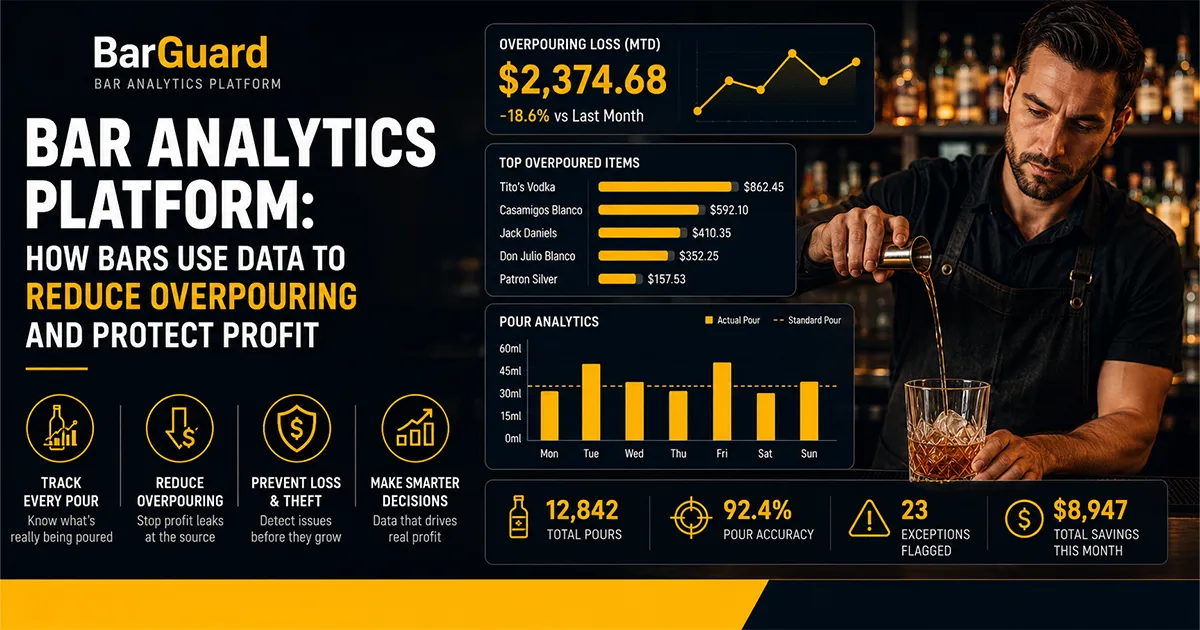
Overpouring rarely looks dramatic while it is happening. A bartender adds a little extra to a regular's drink. A new hire free-pours heavy during the rush. A recipe says 1.5 ounces, but the team has drifted to 2 ounces because nobody checks. The guest is happy, the POS still shows a sale, and the drawer may balance at the end of the night. The loss hides in the bottle.
That is why a bar analytics platform matters. Overpouring is not solved by staring at total sales or counting bottles once a month. It is solved by connecting the data points that show what should have happened against what actually happened: POS sales, recipe specs, inventory counts, purchases, waste logs, comps, voids, discounts, and shift timing. Once those pieces are connected, overpouring stops being a vague suspicion and becomes a measurable pattern.
This guide explains how bar analytics platforms reduce overpouring, what data they need, which reports matter, and how owners can use analytics without turning the bar into a surveillance culture. The goal is not to punish every imperfect pour. The goal is to protect margin by finding repeatable loss before it becomes normal.
The pressure to control these leaks is not theoretical. The National Restaurant Association's State of the Restaurant Industry research continues to show how cost pressure shapes restaurant and bar operations. When product, labor, rent, and insurance all move against the operator, small pour-control problems become real margin problems.
What Is a Bar Analytics Platform?
A bar analytics platform is software that turns operating data into decisions. For inventory and profit control, that usually means combining sales data, recipe data, purchase data, inventory counts, waste logs, and variance reports so the owner can see where profit is leaking.
A basic report might tell you that liquor cost is high. A useful analytics platform tells you which bottles are high, how far they are off, what the dollar impact is, whether the pattern is tied to a shift, whether waste explains it, and whether the problem is more likely recipe drift, overpouring, theft, inaccurate counts, or missing purchases.
That difference matters. "Liquor cost is high" is a complaint. "Tequila usage was 1.8 bottles above expected on Friday and Saturday night, with no matching waste entries and a repeated variance on the same cocktail build" is an action item.
Why Overpouring Is Hard to Catch Without Analytics
Overpouring hides because the sale still exists. If a bartender gives away a full drink without ringing it in, the missing revenue is more obvious once the owner compares inventory to sales. But with overpouring, the drink is sold. The POS says the transaction happened. The problem is that the drink used more product than the recipe expected.
That makes overpouring a usage problem, not just a sales problem. You need to know the recipe, the number of drinks sold, the expected amount of each ingredient, the actual amount that disappeared from inventory, and any legitimate waste that should explain part of the gap. Without that comparison, heavy pours blend into normal product movement.
- ▸Sales reports show what was sold, but not whether each drink was poured to spec.
- ▸Inventory counts show what is left, but not what should have been used.
- ▸Recipes show expected usage, but only if they match how drinks are actually built.
- ▸Waste logs explain legitimate loss, but only if staff record them consistently.
- ▸Shift reports show timing, but only if variance can be connected to the period.
The 5 Data Sources a Bar Analytics Platform Needs
A platform cannot detect overpouring from one number. It needs enough context to separate real loss from normal operations. The cleanest overpouring workflow usually depends on five data sources.
1. POS Sales Data
The POS tells you what guests bought. For analytics, the important details are item sold, quantity, modifier, menu category, discount, void, comp, check time, and employee or revenue center when available. A bar analytics platform uses that sales data to calculate theoretical product usage.
For example, if the POS shows 140 margaritas sold and the recipe uses 2 ounces of tequila per margarita, expected tequila usage for that recipe is 280 ounces. If inventory shows 370 ounces missing after adjusting for purchases and waste, the platform has something to investigate.
2. Recipe and Pour Specs
Recipes are the bridge between sales and inventory. Without recipes, the system cannot know how much tequila, vodka, gin, rum, syrup, juice, or garnish each sale should consume. Recipe accuracy is especially important for cocktails with modifiers, doubles, rocks pours, upsells, substitutions, and batch prep.
Bad recipes create false alarms. If the system says a cocktail should use 1.5 ounces but the bar trains the team to pour 2 ounces, every correct staff pour will look like overpouring. Before blaming staff, analytics should force a recipe audit.
3. Inventory Counts
Inventory counts show actual depletion. Beginning inventory plus purchases minus ending inventory tells you what left the shelf. If counts are inconsistent, variance becomes noisy. If one manager counts bottles in tenths and another estimates in quarters, the analytics will reflect counting style instead of product movement.
This is where the bar inventory variance workflow matters. The point of counting is not only to know what is on hand. The point is to compare actual depletion against what sales and recipes say should have happened.
4. Waste, Comps, and Breakage
Legitimate waste should not be treated as unexplained loss. Broken bottles, spilled cocktails, remakes, bad batches, draft foam loss, training pours, and approved comps all affect inventory. If they are not logged, they inflate variance and make overpouring look worse than it is.
A clean bar waste log gives the analytics platform the context it needs. The log should include item, quantity, reason, employee or shift, timestamp, and manager approval when required. Vague notes like "spill" are not enough.
5. Shift and Employee Context
Overpouring is often a pattern by time, station, product, or shift. If the same variance appears every Friday night, or only when a certain station is open, the owner has a different problem than a random one-time mistake. Shift context helps separate training needs from recipe issues, staffing pressure, or deliberate heavy pouring.
How Analytics Finds Overpouring
A strong platform does not simply say "you lost liquor." It walks the numbers through a chain of questions. What sold? What should those sales have used? What was actually used? What waste was recorded? What remains unexplained? What product, recipe, shift, or daypart is driving the dollar impact?
- 1Pull POS sales for the inventory period.
- 2Map each sold item to its recipe ingredients.
- 3Calculate expected usage for every bottle, keg, wine, mixer, and garnish.
- 4Calculate actual usage from counts and purchases.
- 5Subtract logged waste, comps, breakage, and approved adjustments.
- 6Rank the remaining variance by dollar impact.
- 7Group patterns by item, recipe, shift, station, and date.
The best overpouring analytics are practical. A manager should be able to open the report and see the top products to review first. A 2% variance on a premium tequila may matter more than a 20% variance on a slow-moving syrup. Dollar impact keeps the team focused on profit instead of chasing statistical noise.
The timing matters too. A monthly report may prove that the bar lost money, but it is usually too late to coach the shift, correct the recipe, or remember the service issue that caused the loss. Weekly analytics are much more useful because the team can still connect the numbers to real operations. If the same bourbon is short two weeks in a row, the manager can check the recipe, the count unit, the waste log, the bartender station, and the promotion calendar while the pattern is still fresh.
This is where many bars fall short. They collect data, but they do not create a decision rhythm. A count gets done, a spreadsheet gets saved, and nobody reviews the top variance items until the owner is already frustrated with the P&L. A real analytics workflow should end with an action list: which item is off, what it costs, what probably caused it, who owns the follow-up, and when the next report should confirm whether the fix worked.
The Reports That Matter Most
A bar can drown in dashboards. For overpouring, a few reports matter more than a huge menu of charts. The owner needs reports that connect directly to action.
Expected vs Actual Usage
This is the core report. It compares what should have been used based on POS sales and recipes against what actually disappeared from inventory. It should show quantity variance, cost variance, percentage variance, and dollar impact.
Variance by Item
Item-level variance tells the owner which products are creating the biggest gaps. This is where high-volume spirits, premium bottles, draft beer, and popular cocktail ingredients usually surface. It also prevents vague category-level conclusions like "spirits are off" when the real issue is three specific bottles.
Variance by Recipe
Recipe-level review connects the missing product to the menu. If tequila variance is high, the system should help identify whether the issue is margaritas, palomas, tequila shots, doubles, or a specific modifier. This is how managers know whether to retrain a build, adjust a recipe, or review a promotion.
Waste and Comp Review
Waste and comps are not automatically bad. They become dangerous when they are untracked, vague, or concentrated in odd patterns. A waste report should show total waste dollars, reason codes, top items, shift timing, and who approved the entry.
Shift Pattern Report
A shift pattern report helps owners coach without guessing. If variance clusters on Saturday late night, the fix may be staffing, training, jigger use, manager presence, or station setup. If it follows one product across every shift, the fix may be recipe mapping, bottle size, purchase entry, or count method.
What Analytics Should Not Do
Analytics should not turn every variance into an accusation. Bars are messy operating environments. Bottles break, guests complain, kegs foam, tickets get voided, batches get dumped, and humans make mistakes. The point of analytics is to create a better investigation path, not to assume theft or incompetence from one report.
For broader fraud context, the Association of Certified Fraud Examiners publishes the Report to the Nations, which is useful because it frames why documented patterns matter. In a bar, that means using reports, policies, logs, and repeated variance patterns before taking serious action with staff.
- ▸Do not confront staff over one small variance without checking counts and purchases.
- ▸Do not ignore recipe mapping errors; they create false overpouring signals.
- ▸Do not compare shifts without adjusting for sales mix and volume.
- ▸Do not treat waste logs as perfect if entries are vague or backfilled.
- ▸Do not chase low-dollar variance while high-dollar products keep leaking.
Draft Beer Needs Different Analytics
Draft beer can look like overpouring when the real issue is foam, temperature, line balance, cleaning, glassware, or keg yield. The Brewers Association's Draught Beer Quality Manual is a useful non-competitor reference because draft loss often has equipment and quality causes, not only staff behavior.
A good analytics platform should let managers separate draft variance from spirit variance. A draft issue may need line cleaning, pressure review, temperature correction, or pour training. A spirits issue may need recipe review, measured pours, or shift-level coaching. Treating every category the same leads to weak fixes.
Wine has its own version of this problem. By-the-glass pours drift when staff eyeball glassware, switch between glass styles, or pour heavier for regulars. A one-ounce heavy pour on wine can erase the margin on the final glass of the bottle. Analytics should help managers compare bottle depletion against glass sales and flag wines where the expected number of pours per bottle is not holding up.
Batch cocktails also deserve special handling. A batch may look efficient because service moves faster, but the batch recipe can hide overuse if prep sheets, pour sizes, and sales counts are not connected. If a five-liter batch is supposed to produce 42 servings and the bar only sells 34 before the batch is gone, the issue may be pour size, spillage, prep error, tasting, or waste. Analytics makes that question visible.
How to Roll Out Analytics Without Hurting Culture
The way owners introduce analytics matters. If staff hear "we are watching you," they will resist. If they hear "we are making the numbers fair and clear," the conversation lands differently. Analytics protects good employees too. When waste is logged and variance is measured correctly, honest mistakes do not get mixed with suspicious loss.
- 1Explain the standard: recipes, pour sizes, waste logging, and count process.
- 2Train managers to review patterns, not isolated noise.
- 3Start with product-level coaching before employee-level conversations.
- 4Use the same review cadence every week so reports do not feel selective.
- 5Celebrate improvements when variance drops and margin recovers.
This is also why analytics should connect to operational fixes. If the report shows overpouring on a popular cocktail, the next move might be retraining the build, changing the jigger, adjusting the recipe, moving bottles, simplifying modifiers, or checking whether the menu price still works. The report is only useful if it leads to a specific action.
The best rollout starts with one or two focus areas. Pick high-volume spirits, premium tequila, draft beer, or the top five cocktails. Tell the team what will be measured, show them the recipe standard, and review the results consistently. Once the team sees that the reports are used for coaching and process improvement, not surprise punishment, the data becomes part of the operating rhythm.
Bar Analytics Platform Checklist
If you are evaluating a bar analytics platform to reduce overpouring, look for the workflow behind the dashboard. Pretty charts are not enough. The platform needs to explain product movement in a way your managers can act on.
- ▸POS-connected sales data, not manual sales entry only.
- ▸Recipe mapping for cocktails, modifiers, doubles, and substitutions.
- ▸Inventory counts that support consistent units and partial-bottle estimates.
- ▸Purchase tracking so actual usage is calculated correctly.
- ▸Waste, comp, breakage, and adjustment logs tied to items and shifts.
- ▸Variance reports ranked by dollar impact.
- ▸Reports that separate product, recipe, shift, and category patterns.
- ▸Clear internal links between inventory, recipes, sales, and profit reports.
How BarGuard Reduces Overpouring
BarGuard is built around the comparison most bars are missing: what sold, what should have been used, and what actually left inventory. It connects inventory counts, purchase scanning, recipes, POS sales, waste, and variance into one workflow so owners can find the products and patterns that are quietly draining margin.
That means BarGuard does more than tell you that overpouring is expensive. The over-pouring loss is tied back to specific bottles, recipes, and inventory periods. The variance report shows the gap. The waste log explains legitimate loss. The analytics and reporting tools help owners decide what to fix first.
If your bar is already busy but profit still feels thin, the issue may not be demand. It may be product control. A bar analytics platform gives you the operating visibility to catch heavy pours, recipe drift, untracked comps, draft loss, and suspicious variance before they become part of the culture.
The Bottom Line
A bar analytics platform reduces overpouring by connecting the numbers that usually live apart: POS sales, recipes, inventory counts, purchases, waste logs, and shift patterns. When those data sources line up, the owner can see expected usage, actual usage, variance, dollar impact, and the most likely place to investigate.
The win is not more reports. The win is faster action. Instead of waiting until the month-end P&L shows high liquor cost, managers can see which products are off this week, whether waste explains the gap, and which operational fix will protect margin next week. That is how bars move from guessing about overpouring to controlling it.
BarGuard Catches What You Can't See
Connect your POS, count your inventory, and let BarGuard show you exactly where the gaps are, automatically, every week.