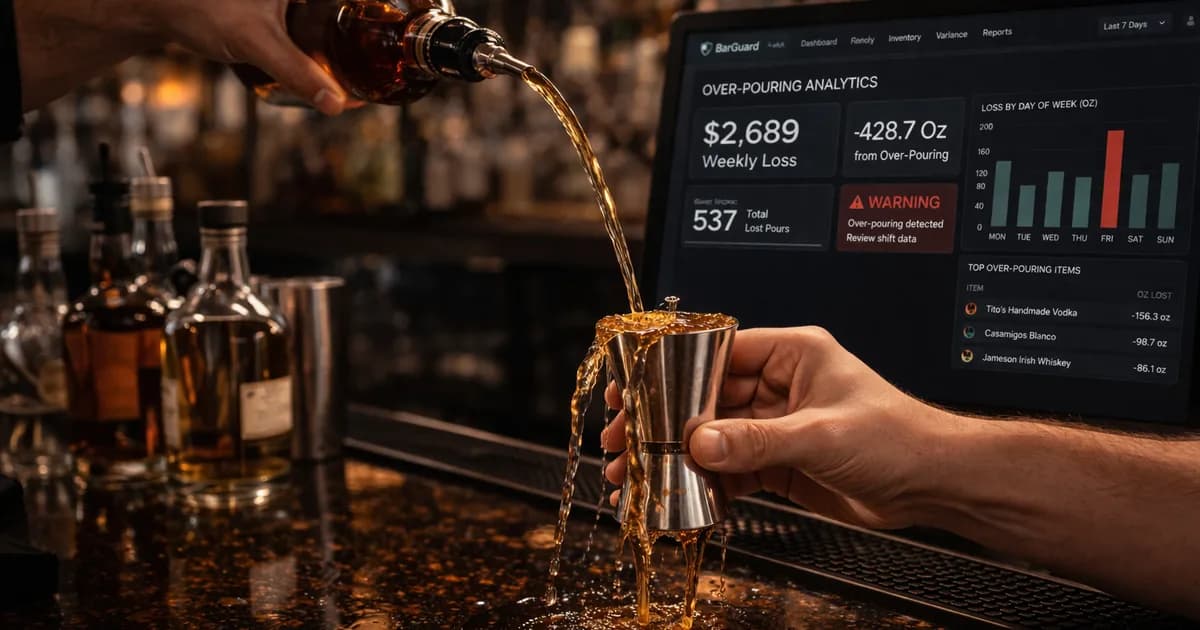
Of all the ways a bar loses money, over-pouring is the most democratic. It doesn't require bad intentions. Your best bartender, the one who's fast, charming, and regulars love, might be your biggest over-pourer. They've got great hands and they're generous. Customers love it. Your margins don't.
The Math Behind Over-Pouring
Let's make this concrete. Say your standard pour is 1.5 oz per drink. Your bartender consistently pours 1.75 oz, a quarter ounce over. That's a 16.7% over-pour on every single drink.
Over-pouring has to be measured against what the POS says was sold. Toast's Product Mix report documentation is a useful POS-side reference because it tracks quantity sold, gross sales, discounts, voids, modifiers, and menu hierarchy for the period under review.
On a slow Tuesday, maybe 80 drinks go across the bar. That's 20 ounces of extra product given away, roughly $15 in cost, maybe $40 in lost revenue. Not catastrophic.
Now it's Saturday night. Two bartenders, 400 drinks between them. At a quarter ounce over per drink, you've given away 100 ounces of product. At $3 to $4 of retail revenue per ounce for mid-shelf spirits, that's $300 to $400 in revenue that never made it to your register. Every Saturday. Every week.
Why Over-Pouring Happens
Free-Pouring Without Training
Free-pouring, measuring by count rather than jigger is fast and looks professional. A trained bartender can free-pour within 5% accuracy. An untrained one can be 30 to 40% off without knowing it. If your bar trains staff to free-pour but doesn't verify their counts regularly, you're operating on trust and hoping for the best.
Generosity as Customer Service
Good bartenders build regulars. Part of how they do it is by being generous. A heavy pour feels like hospitality. Regulars notice it. They come back. They tip better. The bartender's instinct to be generous is actually rational from their perspective. It drives tips. The problem is that generosity with someone else's product is only free if ownership isn't measuring it.
Rush Period Approximation
During a rush, precision goes out the window. A bartender who measures carefully during a slow Tuesday will start approximating when they're slammed on Friday night. Speed and accuracy are genuinely in tension at the bar. The solution isn't yelling at staff to slow down. It's removing the need for manual estimation through consistent tooling.
How to Detect Over-Pouring
The only reliable way to detect over-pouring is through the variance between your theoretical usage (what your POS says you should have used, based on drinks sold) and your actual usage (what your physical inventory counts show). If your POS says you sold 40 shots of bourbon but your counts show 52 shots worth of bourbon consumed, the difference is either over-pouring, theft, waste, or comps, and you need to know which.
- ▸Run theoretical vs. actual comparisons after every inventory count.
- ▸Segment variance by product category, over-pouring tends to cluster on your highest-volume spirits.
- ▸Correlate variances with shift schedules to identify whether certain staff or certain nights drive the discrepancy.
- ▸Use spot checks: measure a bartender's pours during a quiet moment without making it confrontational.
How to Fix Over-Pouring
Standardize with Jiggers
Requiring jigger use is the most direct fix. Yes, it's slower. Yes, some bartenders will push back. But a measured pour is always going to be more accurate than a counted one, especially under pressure. Many craft cocktail bars have successfully reframed jigger use as quality-focused rather than distrust-signaling.
Train and Test Free-Pour Counts
If your bar culture requires free-pouring, invest in real training. The standard test: have bartenders pour into a jigger over a count of 1, 2, 3, 4 seconds, and measure what comes out. Do this regularly. Pour counts drift over time, especially with new bottles that pour differently than old ones.
Use Measured Pourers
Measured speed pourers, which dispense a fixed volume per pour, are a middle ground between jiggers and free-pouring. They maintain pour speed while enforcing a fixed measurement. They're particularly effective on high-volume well spirits where precision matters most.
Make the Data Visible
When bartenders know their section's pour cost and variance data, behavior changes. This isn't about surveillance. It's about accountability. Most over-pouring is unintentional. When staff can see the impact of their pours on your bar's real profit, they adjust. Visibility is often more powerful than enforcement.
The Bottom Line
Over-pouring is fixable. It doesn't require firing good bartenders or turning your bar into a joyless measuring exercise. It requires data, knowing where your variance is coming from, and targeted action based on what that data shows. The bars that get it under control typically save 3 to 8% of their liquor revenue, which at any meaningful volume is thousands of dollars a month flowing back to the bottom line. For a full breakdown of causes and prevention strategies, see what overpouring actually costs your bar. Start with bar inventory software that tracks pour variance by shift, use the data to reduce your liquor cost percentage, or see how BarGuard works before you commit.
Frequently Asked Questions
How much money does over-pouring cost a bar?
A ¼ oz over-pour per drink costs approximately $0.25 to $0.75 per drink depending on the spirit. Across 200 drinks on a busy night, that's $50 to $150 per shift per bartender. With three bartenders working five nights a week, annual over-pouring losses can easily exceed $50,000.
What is the standard pour for a bar?
The standard pour for a cocktail or straight spirit is 1.5 oz in most US bars. Some bars use 1.25 oz to lower pour cost, others use 2 oz for premium cocktails. Beer is typically 12 to 16 oz depending on the glass. Wine pours are usually 5 to 6 oz. The standard should be set, documented, and consistent across all bartenders.
How do you know if your bartenders are over-pouring?
The most reliable way is to compare POS sales data to physical inventory counts. If your inventory shows more product used than your POS says you sold, the gap is over-pouring (or theft). Tracking this per shift and per bartender tells you exactly who is pouring heavy and when.
Does using a jigger slow down service?
A practiced bartender using a jigger is almost as fast as free-pouring, and significantly more accurate. The speed difference is measured in seconds per drink. The revenue difference is measured in thousands of dollars per year. Most bartenders who resist jiggers haven't actually timed themselves. The resistance is habit, not speed.
The Real Cost of a Quarter-Ounce Over-Pour
A quarter ounce does not feel expensive in the moment. On one drink, it may only be a few cents or a few dimes depending on the spirit. But bars do not lose money one drink at a time in isolation. They lose it when the same small mistake repeats across hundreds or thousands of pours.
If a bartender over-pours tequila by 0.25 oz on 200 margaritas in a week, that is 50 extra ounces of tequila. That is almost two full 750ml bottles. If the bottle costs $32, the weekly loss is roughly $64 on that one drink build. Multiply that by multiple spirits, multiple bartenders, and multiple weeks, and the annual number becomes uncomfortable fast.
Hidden Losses Beyond the Bottle Cost
The bottle cost is only the first layer. Over-pouring also weakens menu pricing, makes recipes unreliable, creates inconsistent guest expectations, and trains regulars to expect stronger drinks than the business priced. It can also make honest bartenders look inconsistent because guests compare drinks from different shifts.
- ▸Lower gross profit on every affected cocktail.
- ▸Inaccurate pour cost reporting because usage is higher than recipes predict.
- ▸Guests expecting stronger drinks without paying for doubles.
- ▸Harder training because the unofficial pour becomes the real standard.
- ▸False suspicion of theft when the actual issue is portion control.
How to Calculate Over-Pouring Losses
- 1Find the recipe pour size for the item or cocktail.
- 2Pull POS sales for the same period.
- 3Multiply sales by recipe usage to get expected ounces.
- 4Compare expected ounces to actual inventory usage.
- 5Convert the difference into bottle cost and menu-margin impact.
This calculation is exactly why connected inventory matters. If expected usage and actual usage live in separate spreadsheets, most managers never do the math. BarGuard connects the count, recipe, and POS data so the dollar impact is visible without rebuilding the report by hand.
Why Over-Pouring Losses Compound Faster Than Owners Expect
Over-pouring losses compound because they usually happen on the products that sell the most. A slow-moving bottle can be slightly off without changing the monthly numbers much. A top-selling vodka, tequila, bourbon, or rum can create serious loss with a small mistake because the pour repeats all night. The more successful the drink, the more expensive the mistake becomes.
The problem also compounds through guest expectation. If regulars learn that one bartender pours heavy, they come back expecting that drink strength. The next bartender who follows the recipe may look stingy. Now the bar has a consistency problem and a margin problem, both caused by an unofficial pour standard.
A Simple Over-Pouring Loss Audit
- 1Pick the ten highest-volume spirits or cocktail ingredients.
- 2Confirm the recipe pour for each menu item using those products.
- 3Pull POS sales for one week.
- 4Calculate expected ounces used from recipes and sales.
- 5Compare expected ounces to counted actual usage.
- 6Convert the extra usage into bottle cost and lost gross profit.
Run this audit before changing prices. If the drink is priced correctly but poured incorrectly, raising the price may hide the issue for a while but does not fix the leak. If the drink is poured correctly but priced too low, then pricing is the right lever.
How to Turn Over-Pouring Data Into Action
Once you know the dollar impact, choose one action that matches the pattern. If one product is off across all shifts, audit the recipe and glassware. If one shift is off, coach the team working that shift. If weekend volume creates the issue, add measured-pour reinforcement during peak hours. The action should be specific enough that the next count can prove whether it worked.
This is where owners often go wrong. They remind everyone to pour carefully, but they do not measure the same item again. Without follow-up, the team hears a complaint instead of a standard. A good over-pouring control process always closes the loop.
Owners should also compare over-pouring losses to labor and marketing spend. A few bottles a week may look small until you realize the annual loss could cover software, training, new tools, or part of a manager bonus. The money is already in the building; the control system decides whether it stays there.
Once the loss is measured, set a follow-up date. A training note without a second count is just a reminder. A training note followed by cleaner variance proves the bar changed behavior and protected margin.
That proof matters because over-pouring control should feel operational, not personal. The team sees the standard, the owner sees the numbers, and everyone knows what improved before the next busy weekend.
For a busy bar, this is one of the easiest profit leaks to underestimate because guests are still happy and sales still look healthy. The loss hides in the gap between what was sold and what was actually poured during service.
Measure it weekly until the pattern is gone, then keep it on the regular variance checklist.
Frequently Asked Questions
What causes over-pouring at bars?
Over-pouring is caused by free-pouring without a jigger, lack of training on standard pour sizes, intentional generosity to earn tips, and inconsistent glassware. A bartender free-pouring 1.75 oz instead of 1.5 oz adds 17% extra alcohol to every drink, at volume, that adds up to thousands of dollars in annual loss.
How much does over-pouring cost a bar per year?
A bar over-pouring by just 0.25 oz per drink can lose $50,000 or more annually depending on volume and price point. Over-pouring is typically the single largest driver of bar shrinkage, responsible for 40 to 50% of inventory loss at most operations.
How do you stop over-pouring at a bar?
Require jigger use for all spirit pours. Standardize recipes with exact measurements. Run regular variance reports to identify which staff or shifts show consistent over-depletion. Use pour cost comparisons to flag drinks where actual cost significantly exceeds theoretical cost.
What is the difference between over-pouring and bartender theft?
Over-pouring is typically unintentional. Bartenders free-pour generously without measuring. Theft involves deliberate actions: ringing up fewer drinks than served, charging guests while voiding sales, or stealing cash outright. Both cause inventory variance, but theft patterns often appear on specific shifts or with specific staff.
BarGuard Catches What You Can't See
Connect your POS, count your inventory, and let BarGuard show you exactly where the gaps are, automatically, every week.