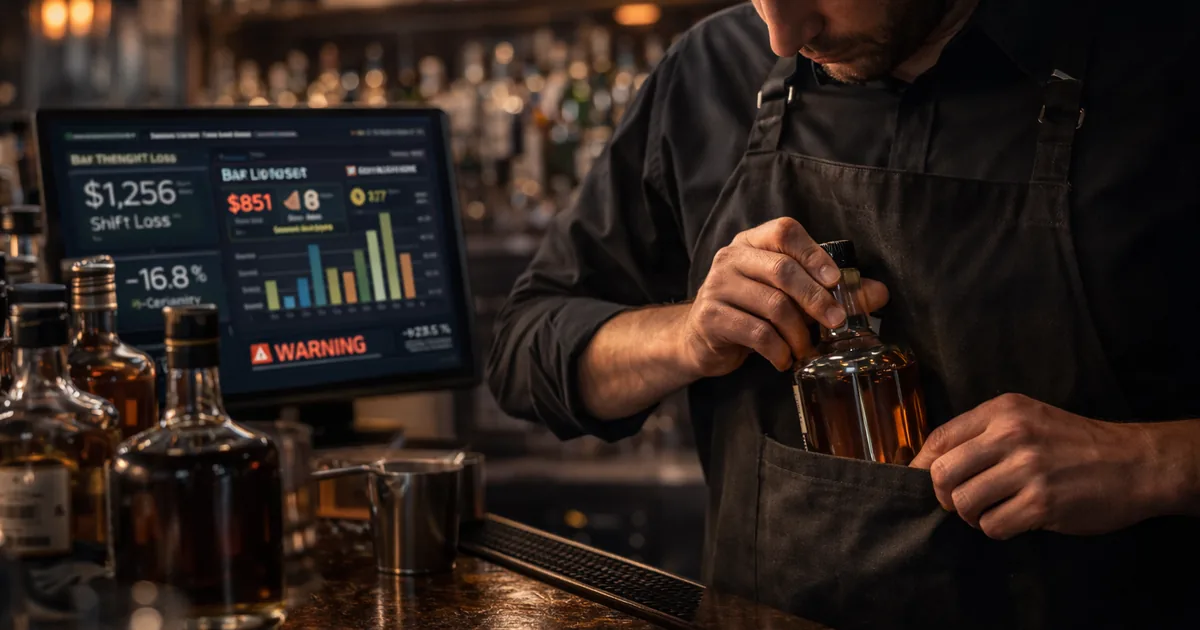
Nobody wants to believe their bartender is stealing from them. You hired them. You trained them. Maybe you've known them for years. But the data is uncomfortable: industry studies consistently find that internal theft, by employees, not customers, accounts for 35 to 40% of all bar shrinkage. That's not a rounding error. It's a line item.
The harder truth is that most bartender theft isn't dramatic. It's not a case you'll catch on camera. It's a pattern of small decisions, a drink not rung up, a bottle walked to a friend's table, cash pocketed on a round that never hit the register. That compound quietly over months before ownership notices something is wrong.
Employee theft should be handled with evidence, policy, and care, not guesswork. For broader fraud context, see the ACFE Report to the Nations; for wage and tip-compliance boundaries when managing tipped staff, the U.S. Department of Labor's FLSA tipped employee fact sheet is a useful primary source.
How Bartender Theft Actually Happens
Understanding the methods matters because the red flags are different for each one. Most theft at the bar falls into five categories:
1. Short Ringing
A customer orders four drinks. The bartender rings up three and pockets the cash difference on the fourth. Done fast enough, it's invisible to the customer and to you. Short ringing is most common at high-cash bars with no mandatory POS entry before drinks are made. The tell: cash sales are consistently lower than volume would suggest, but only on certain shifts.
2. Sweethearting
This is free drinks for friends, regulars, or anyone the bartender wants to impress. A round gets poured and a cash transaction occurs. The bartender rings up nothing, pockets nothing, but your product still disappears. Sweethearting is often thought of as "just being friendly," but at scale it's directly reducing your margins. The tell: your usage-to-sales ratio climbs on nights certain staff work, but cash shortages are rare.
3. Void and Refund Abuse
A bartender rings up a sale, takes cash from the customer, then voids the transaction and keeps the money. Modern POS systems log all voids, but only if someone is reviewing that log. A bartender who knows the manager never checks voids has a nearly risk-free method. The tell: high void rates on certain employees or certain shifts, especially on cash transactions.
4. Bottle Walking
Bottles disappear. Sometimes it's one a week, sometimes more. High-end spirits are the most common target, a $60 bottle of tequila walked out the back door once a week is $3,000 a year gone before you notice the storage count is off. The tell: specific SKUs showing high variance that doesn't correlate with sales volume.
5. Phantom Inventory Manipulation
Less common but most damaging at scale: a bartender or manager who's also doing inventory counts can manipulate numbers to cover up ongoing theft. They'll count high on items where they're stealing to keep the variance invisible. The tell: implausibly clean variance reports, especially if the same person conducts counts every cycle.
Warning Signs You Should Be Watching For
None of these signals alone prove theft. But multiple signals appearing together, especially correlated with specific employees or shifts is your data telling you to look harder.
- ▸Inventory variance climbs on the same nights the same bartender is scheduled.
- ▸Your cash drawer runs short more frequently on certain shifts, even after tips are reconciled.
- ▸Void and comp rates are unusually high for one employee vs. the rest of the team.
- ▸Your POS shows low drink counts on nights the bar was visibly busy.
- ▸Specific high-value bottles consistently show higher-than-expected depletion.
- ▸A bartender's section always runs out faster than others, but their sales numbers don't reflect it.
- ▸You notice friends or regulars of a specific bartender drinking heavily but the table's check is small.
- ▸Inventory counts seem oddly clean, suspiciously little variance, right after a personnel change.
How to Catch It: The Data Approach
The old approach to catching theft was cameras, tip-offs, and gut instinct. The modern approach is variance data, and it's more reliable, less confrontational, and much harder to argue with. Shift-based theft detection surfaces patterns that no camera ever would.
The core method is simple: compare what your POS says you sold against what your inventory counts say you consumed. If 30 oz of rum disappeared from your inventory but your POS only shows sales that account for 22 oz, 8 oz is unaccounted for. That 8 oz is your evidence. It doesn't tell you who did it, but it tells you theft, waste, or over-pouring is happening at a measurable scale. For a full walkthrough of the variance-based approach, see how to catch bartender theft without accusing your staff.
- 1Run variance reports after every inventory count, broken down by product category.
- 2Cross-reference high-variance days and times with your schedule to see if specific shifts or employees correlate.
- 3Pull your POS void and comp logs weekly, most modern POS systems have this report built in.
- 4Track your cash-over/short by shift and by employee over time. A bartender averaging -$15/shift in cash drawers is a pattern, not bad luck.
- 5If you find a consistent pattern on one employee, document it across at least 3 to 4 count cycles before acting.
How to Address It Without Destroying Your Team Culture
This is where most owners freeze. The data points at someone. Now what?
If the variance is ambiguous, one bad week, no strong pattern, address it structurally rather than personally. Tighten controls, increase count frequency, add a manager review of voids. Make the system harder to exploit without singling anyone out.
If the pattern is clear and consistent, have a direct conversation grounded in data, not accusation. "Our variance on vodka has been running 18% over the last four weeks, and it's concentrated on Tuesday and Thursday shifts. I need to understand what's happening." Let the data do the work. Most people will fold when you show them the numbers.
When termination is warranted, consult your state's employment laws before acting. Document everything. Your variance reports and POS logs are your paper trail.
Prevention Is Cheaper Than Detection
The most effective anti-theft strategy is making theft difficult and detectable before it starts. When your team knows that variance is tracked weekly, that void logs are reviewed, and that inventory is counted by someone other than them, the calculus changes. Most theft is opportunistic, not premeditated. Remove the opportunity. Bar inventory software that runs shift-based variance automatically is the strongest deterrent you can put in place.
- ▸Require POS entry before any drink is poured, no exceptions, no pre-making drinks.
- ▸Have a manager or owner review void and comp reports weekly.
- ▸Rotate who counts inventory, never the same person two cycles in a row.
- ▸Conduct random spot counts mid-week in addition to your regular cycle.
- ▸Make variance data visible to your management team so everyone knows it's being watched.
- ▸Set clear, written policies on comps, employee drinks, and voids so there's no gray area.
The Bottom Line
Bartender theft is an uncomfortable topic, but avoiding it doesn't protect your business. It just keeps you in the dark. The good news is that modern inventory tracking makes it easier than ever to see what's actually happening at your bar, identify patterns before they become expensive, and address problems with data rather than drama. Tighter controls also help you reduce your overall liquor cost, theft and over-pouring almost always compound each other. You don't have to run your bar like a prison. You just have to run it like a business.
For a deeper breakdown of the tactics behind these warning signs, see the 15 common bartender theft methods bar owners should know, and what each one looks like in your variance data.
Prevention Works Best When Controls Are Normal
The best theft prevention systems feel like normal operations, not sudden suspicion. Weekly counts, manager-approved comps, clear void rules, recipe standards, and variance review should apply to everyone. When controls are routine, honest bartenders are protected and dishonest behavior has less room to hide.
This matters because theft often grows in loose systems. If free drinks are common, voids are rarely reviewed, and inventory is counted inconsistently, it is hard to tell the difference between generosity, mistakes, and intentional loss. Clear rules remove that gray area.
Warning Signs That Deserve a Closer Look
- ▸High comps or voids compared with other bartenders on similar shifts.
- ▸Cash tips that rise while POS sales stay flat.
- ▸Repeated variance on products used heavily by one shift.
- ▸Guests receiving drinks before tickets appear in the POS.
- ▸Open tabs, deleted items, or no-sales that cluster around one employee.
- ▸Resistance to standard counts, measured pours, or manager review.
None of these signs proves theft by itself. They are prompts for review. The right next step is to compare POS activity, inventory variance, schedule data, and manager observations before making a decision.
How to Prevent Theft Without Hurting Culture
- 1Set clear comp, void, and shift-drink policies in writing.
- 2Make inventory variance review a normal weekly process.
- 3Use manager approvals for high-risk POS actions.
- 4Train bartenders on why pour standards protect the business.
- 5Praise clean shifts and improvement, not just catch problems.
BarGuard supports prevention by making variance visible quickly. When the team knows product movement is measured consistently, the easiest path is to follow the process.
Theft Prevention Policies Every Bar Should Document
Verbal rules fade during busy service. Written policies give managers and bartenders the same standard. Document who can approve comps, when voids are allowed, how shift drinks are rung, what happens to broken bottles, who can access locked storage, and how often high-value inventory is counted.
The policy does not need to be harsh. It needs to be clear. If everyone knows the rules, honest mistakes are easier to coach and dishonest behavior is harder to hide. Consistent enforcement is what makes the policy credible.
Use Inventory Variance as an Early Warning System
Theft prevention improves when managers see variance quickly. Waiting until month end gives patterns time to grow. Weekly variance review on premium spirits, high-volume well bottles, and products tied to suspicious POS activity gives owners a faster signal.
- ▸Review high-value bottles weekly.
- ▸Compare variance against schedules and POS activity.
- ▸Look for repeated patterns before assuming intent.
- ▸Follow up on the same items after controls are changed.
This is where BarGuard fits the prevention workflow. It helps surface unexplained product movement early, so managers can review the right items, shifts, and controls before losses become normal.
Review Controls After Every Incident
If theft or serious policy abuse is confirmed, do not stop at the employee decision. Review the control that failed. Was storage access too loose? Were voids approved after the fact? Were high-value bottles counted too rarely? Did managers ignore variance for several weeks? Fixing the control prevents the same loss from returning under a different person.
The strongest prevention culture is calm, consistent, and documented. Everyone knows the rules, managers review the numbers, and the business reacts to patterns quickly. That is how a bar protects margin without making every shift feel hostile.
Prevention also gets easier when managers share the why. Controls are not about distrusting the whole team. They protect honest employees, keep expectations clear, and make sure the bar can afford the products, hours, and service standards guests expect.
Frequently Asked Questions
What are the signs of bartender theft?
Key warning signs include consistent inventory variance on specific shifts, high void or comp rates for one staff member, cash discrepancies after their shifts, and guest complaints about overcharging. Theft often shows up first in the numbers, a bartender whose shifts consistently show over-depletion relative to sales is the clearest signal.
How common is bartender theft?
Industry research estimates that 35 to 40% of bar inventory loss comes from internal theft. Most incidents involve opportunistic behavior, underringing drinks, giving free pours in exchange for cash tips, or walking out with product. Organized theft schemes are less common but cause larger losses when they occur.
What controls prevent bartender theft?
The most effective controls are: requiring all transactions to be rung before the drink is made, using inventory variance reports to spot depletion gaps by shift, locking back-stock between service periods, and reviewing void and comp reports regularly. Visibility is the strongest deterrent, theft rates drop when staff know counts are being compared to sales.
Should I confront a bartender I suspect of theft?
Do not confront before you have documented evidence. Gather variance reports, POS data, and camera footage that shows a pattern. Involve ownership or HR and follow your written disciplinary policy. Acting on suspicion alone creates liability and rarely resolves the underlying problem.
BarGuard Catches What You Can't See
Connect your POS, count your inventory, and let BarGuard show you exactly where the gaps are, automatically, every week.