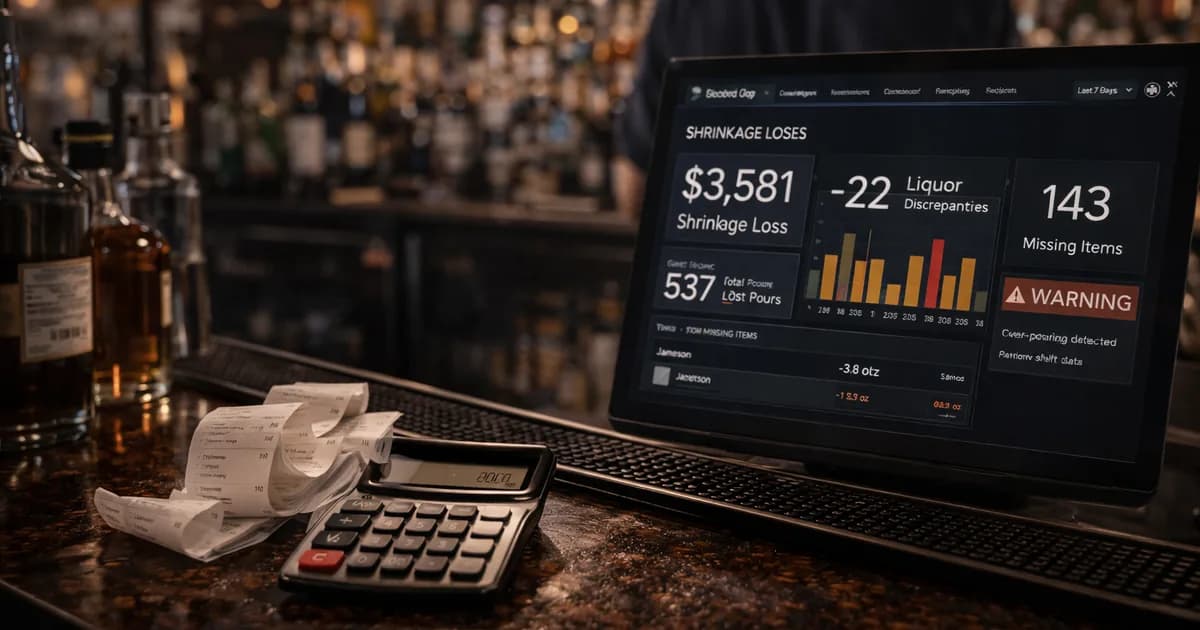
What Is Bar Shrinkage?
Shrinkage is the difference between what your inventory records say you should have and what you actually have on the shelf. It's the gap between theoretical usage, based on your sales data, and actual usage, based on physical bottle counts. Closing that gap early is the whole point of managing bar inventory on a schedule instead of a hunch.
Unlike other industries, bar shrinkage is uniquely difficult to track because alcohol is dispensed in small, unmeasured increments dozens or hundreds of times per shift. A half-ounce over-pour here, a free drink there, a bottle that disappears off the back shelf. It all adds up faster than most owners realize.
Bar shrinkage is the gap between what your inventory should show and what is physically left after service. You had a great Saturday night. The bar was packed, drinks were moving, and your register looked solid. But when you count your bottles on Monday morning, something does not add up. You sold what should have been 18 bottles of vodka, but you are missing 22. That gap is shrinkage, and it is one of the most expensive silent problems in the bar industry.
Shrinkage is not only a bar problem; it is a broader fraud and loss-control problem. The Association of Certified Fraud Examiners publishes the Report to the Nations on occupational fraud, and restaurant operators can pair that broader risk lens with POS reports and inventory counts to make loss visible.
The 4 Main Causes of Bar Shrinkage
1. Theft
Internal theft, by bartenders, barbacks, or managers accounts for roughly 35 to 40% of bar shrinkage according to industry studies. It takes many forms: bottles walked out the back door, drinks rung up as water but poured as liquor, cash pocketed on unrecorded sales, or simply sipping on shift. The challenge is that theft at the bar level is almost impossible to detect without hard data comparing what was sold versus what was consumed. That's exactly what shift-level theft detection software is built to surface.
2. Over-Pouring
This is often unintentional but just as costly. A bartender who consistently pours 1.5 oz instead of 1.25 oz, a difference of just a quarter ounce, is effectively giving away 20% of every drink for free. On a busy Friday night with 300 drinks served, that's 60 free drinks your customers got but never paid for. Over-pouring is the single largest contributor to shrinkage at high-volume bars.
3. Spillage and Waste
Spilled drinks, failed cocktails, broken bottles, and over-blended batches all represent real product loss. A standard allowance of 1 to 2% for spillage is acceptable. If yours is higher, it's a training and workflow problem worth addressing.
4. Comps and Unauthorized Free Drinks
Some comps are intentional and tracked, a manager buys a round for a loyal customer and records it. But many aren't. Bartenders buying rounds for friends, sliding a free shot to a regular, or "forgetting" to ring up a drink for the group that tipped well. These all drain your inventory without appearing in your sales data.
How to Calculate Your Shrinkage Rate
Calculating shrinkage requires two numbers: theoretical usage and actual usage.
- 1Count your opening inventory at the start of a period (a week or a month works well).
- 2Add any purchases received during the period.
- 3Count your closing inventory at the end of the period.
- 4Calculate actual usage: Opening inventory + Purchases − Closing inventory.
- 5Pull your sales data and calculate theoretical usage: what your POS says you should have sold based on your drink recipes and recorded transactions.
- 6Shrinkage = (Actual usage − Theoretical usage) ÷ Actual usage × 100.
For example: you actually used 30 liters of vodka this week. Your POS says you should have used 24 liters based on recorded sales. Your shrinkage rate is (30 − 24) ÷ 30 = 20%. If that six-liter gap is mostly spirits, the dollar impact can compound quickly across a full month of service.
Red Flags You Have a Shrinkage Problem
- ▸Your inventory never seems to match your sales numbers, but you can't identify why.
- ▸Certain bartenders' sections consistently run low faster than others.
- ▸Your pour cost percentage is higher than your recipe costing suggests it should be.
- ▸You've noticed bottles moving between shifts without explanation.
- ▸Sales on certain spirits are flat but consumption is up.
- ▸Staff turnover seems oddly correlated with your inventory discrepancies.
How to Stop Shrinkage Before It Drains You
The most important thing you can do is start measuring. You cannot manage what you don't measure, and most shrinkage problems thrive in the dark precisely because ownership doesn't have the data to see them. The variance-based method covered in how to catch bartender theft without accusing your staff gives you exactly that visibility, systematically, without confrontation.
- ▸Count inventory on a consistent schedule. Weekly is the industry standard.
- ▸Compare your actual usage against your POS-based theoretical usage every count cycle.
- ▸Track variances by category (spirits, beer, wine, NA) and by location (bar station, back bar, storage).
- ▸Use portion control tools, jiggers, measured pourers, or speed rails with standard pours, to reduce accidental over-pouring.
- ▸Require comp logging: every free drink should be recorded in the POS against a comp account.
- ▸Cross-train managers to review variance reports, not just bartenders to pour drinks.
The bars that get shrinkage under control share one thing: they treat inventory data as seriously as they treat their P&L. Shrinkage isn't a moral failing. It's a data problem. Give yourself the data, and you can fix it. For a full breakdown of causes and benchmarks, see what beverage shrinkage is and how to calculate your rate. The fastest path to fixing it is bar inventory software that flags expected-vs-actual gaps automatically, then use those numbers to reduce your liquor cost to a sustainable target.
Frequently Asked Questions
What is a normal shrinkage rate for a bar?
The industry average is 20 to 25% of inventory annually. A well-managed bar with consistent tracking and portion control can get this below 10%. Above 30% typically indicates a systemic problem, chronic over-pouring, theft, or both.
How do you calculate bar shrinkage?
Bar shrinkage = (Actual usage − Theoretical usage) ÷ Actual usage × 100. Actual usage comes from physical inventory counts (beginning inventory + purchases − ending inventory). Theoretical usage is calculated from your POS sales data and recipes. The gap, divided by what was actually used, is your shrinkage rate.
What is the difference between shrinkage and waste?
Waste is product lost through accidents, spillage, or spoilage, unintentional loss. Shrinkage is the broader category that includes waste plus intentional loss like theft, unrecorded comps, and over-pouring. Waste is a subset of shrinkage.
Can inventory software really stop shrinkage?
Inventory software doesn't stop shrinkage directly. It makes it visible. When bartenders and managers know that variance is tracked per shift and per item, over-pouring and theft decrease. Bars using systematic tracking catch losses 4x faster and reduce pour cost by 3 to 8 percentage points on average.
Shrinkage Includes More Than Theft
Many owners hear shrinkage and think theft first. Theft matters, but shrinkage is broader. It includes over-pouring, waste, breakage, unrecorded comps, recipe errors, receiving mistakes, transfers that never get logged, and product that expires or dies on the shelf. Treating every shrinkage number like theft creates the wrong response.
The better approach is to classify the loss. Was the product sold? Was it wasted? Was it comped? Was it transferred? Was it counted incorrectly? Was it expected by the recipe? Each answer points to a different fix. Shrinkage control is not about blaming the team. It is about making product movement visible enough that managers can respond correctly.
How to Estimate Your Monthly Shrinkage Cost
- 1Start with opening inventory value.
- 2Add purchases received during the month.
- 3Subtract closing inventory value.
- 4Compare actual usage to expected usage from POS sales and recipes.
- 5Convert unexplained usage into dollars by item cost.
- 6Review the highest-dollar gaps first.
If actual usage is $18,000 and expected usage is $15,500, the unexplained gap is $2,500 for the period. Some of that may be legitimate waste or recorded comps, but any amount that cannot be explained is shrinkage risk. The goal is not to hit zero. The goal is to reduce unexplained loss and catch patterns quickly.
Where Shrinkage Usually Hides in a Bar
- ▸Premium spirits stored without location-level counts.
- ▸Draft beer loss from foam, line issues, or undocumented keg changes.
- ▸Cocktails with recipes that do not match the actual pour.
- ▸Manager comps and staff drinks that are not rung correctly.
- ▸Breakage and spills that are cleaned up but never recorded.
- ▸Back-stock transfers between bars, events, and storage rooms.
BarGuard is useful because it does not treat shrinkage as one blended number. By comparing expected and actual usage at the item level, it helps owners find the specific products causing the loss and decide whether the fix is process, pricing, training, or investigation. For the operational math behind that comparison, use the bar inventory variance formula alongside your weekly shrinkage review.
Shrinkage Benchmarks Are Less Useful Than Your Trend
Owners often ask what a normal shrinkage percentage should be. Benchmarks can be helpful, but your own trend is more important. A bar moving from 6% unexplained loss to 11% has a problem even if another concept would tolerate that number. A bar moving from 15% to 9% is improving even if there is still work to do.
Track shrinkage by category and by dollar impact. Spirits, draft beer, wine, and mixers behave differently. A single blended shrinkage number hides too much. High-value spirits may need tighter controls, while draft beer loss may point to foam, line maintenance, keg handling, or tap waste. For the beer-specific workflow, use the draft beer shrinkage guide to measure foam, waste, and keg variance separately.
How to Reduce Shrinkage in 30 Days
- 1Clean inventory item names so products do not split across duplicate rows.
- 2Enter purchases before every count is finalized.
- 3Count high-value products weekly and sort variance by dollar impact.
- 4Record comps, waste, spills, and transfers in the POS or inventory workflow.
- 5Review the same high-loss products again after each corrective action.
The first 30 days should focus on visibility, not perfection. Once product movement is recorded consistently, the bar can tell which problems are real and which were caused by messy data. After that, shrinkage reduction becomes a weekly management habit.
Shrinkage Red Flags Owners Should Not Ignore
- ▸Repeated variance on the same premium bottles.
- ▸Inventory loss that spikes during specific shifts or events.
- ▸High comps or voids without a clear manager explanation.
- ▸Frequent emergency purchases despite normal sales volume.
- ▸Counts that change dramatically depending on who performs them.
- ▸Products that disappear from storage before reaching the bar.
Why Shrinkage Should Be Reviewed Weekly
Monthly shrinkage review is too slow for high-volume bars. By the time the number reaches accounting, the shift details are stale and the product is gone. Weekly review gives managers enough time to remember events, check cameras if needed, correct recipes, and coach the right team. It also keeps small loss from becoming normal.
A weekly review does not require counting every item in the building. Count the high-risk products, review purchases, compare expected and actual usage, and document the top issues. Then use the monthly review to look for broader trends across categories and supplier costs.
The most useful shrinkage reports are simple enough to act on. Show the product, expected usage, actual usage, variance units, variance dollars, and likely explanation. If the report takes an hour to understand, managers will not use it during a busy week. If it points to the biggest losses first, it becomes part of the operating rhythm.
That rhythm is what changes behavior. Staff know counts are consistent, managers know follow-up is expected, and owners can see whether controls are working. Shrinkage stops being a vague accounting worry and becomes a weekly operational number the team can improve.
Start with the products that combine high cost and high movement. Premium tequila, well vodka, bourbon, draft beer, and top cocktail ingredients usually deserve the closest review. If those items improve, total shrinkage often improves quickly because they represent the biggest repeated exposure.
From there, build the habit into manager meetings. Shrinkage should have an owner, a next action, and a date for review. Otherwise it becomes another report that describes loss after it already happened and keeps repeating.
Do not wait for perfect data to start. Even a simple weekly review of top products can reveal whether loss is getting better or worse. As the process improves, the numbers become more precise and the corrective actions become easier to trust.
Frequently Asked Questions
What is bar shrinkage?
Bar shrinkage is the gap between what your inventory records say you have and what is physically on the shelf. It includes losses from over-pouring, bartender theft, unrecorded spillage and breakage, free drinks, and vendor short-shipments. The average bar loses 20 to 25% of its inventory annually to shrinkage.
How do you calculate bar shrinkage?
Actual usage = Opening Inventory + Purchases − Closing Inventory. Shrinkage = Actual Usage − Expected Usage. Expected usage is what your POS sales data and recipes say should have been consumed. To express it as a percentage, divide the unexplained gap by actual usage or inventory value and track the same method consistently over time.
What percentage of bar losses come from bartender theft?
Industry data indicates internal theft accounts for roughly 35 to 40% of bar losses. Over-pouring is typically the largest single cause, responsible for 40 to 50%. Spillage, waste, and vendor errors make up the remainder. Most theft in bar environments is opportunistic, not premeditated.
How can a bar reduce shrinkage?
Start with consistent weekly inventory counts so variance is visible quickly. Match count data to POS sales and recipes to find where depletion exceeds expectation. Use jiggers and standardized recipes to control pour sizes. Limit access to back-stock and document waste and comps in real time rather than estimating after the fact.
BarGuard Catches What You Can't See
Connect your POS, count your inventory, and let BarGuard show you exactly where the gaps are, automatically, every week.