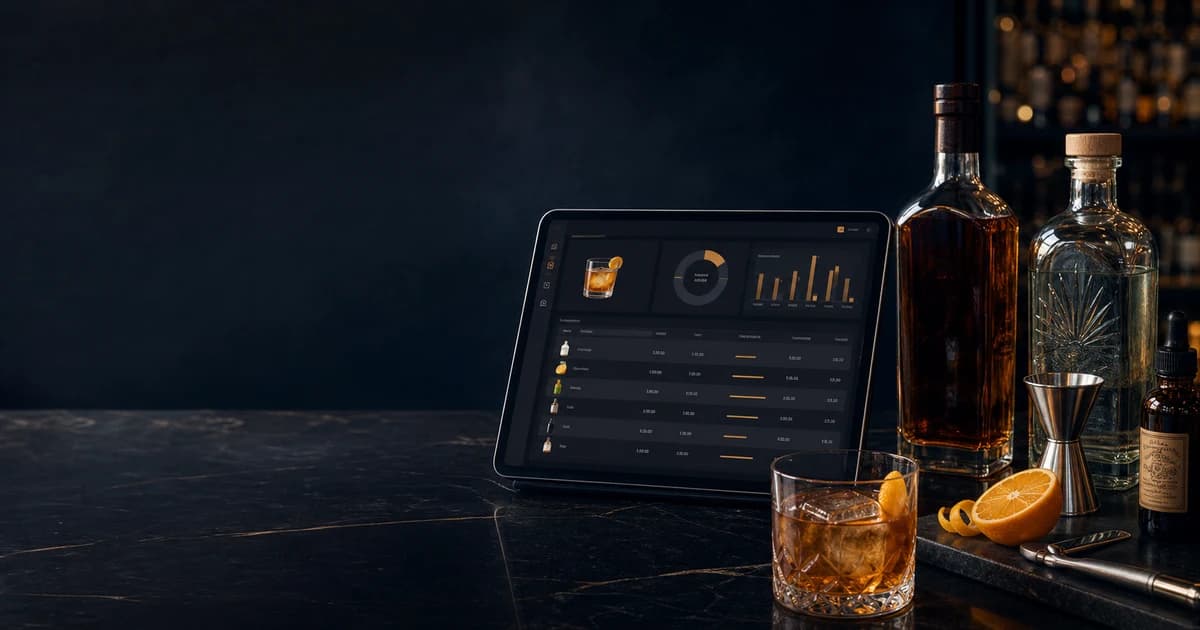
Cocktail recipe costing is how a bar finds the real cost of every drink on the menu. Not the guess. Not the old number from the opening spreadsheet. The real cost today, based on current bottle prices, exact pour sizes, mixers, syrups, juices, bitters, garnishes, modifiers, and the waste that happens before a drink ever reaches the guest.
A lot of bars know what they charge for a margarita, old fashioned, espresso martini, or house spritz. Fewer know what that drink actually costs to build this week. That gap matters because recipe cost is the foundation for drink pricing, pour cost, menu engineering, inventory variance, and profit reporting. If the recipe cost is wrong, every decision built on top of it starts drifting.
The good news is that recipe costing is not complicated once the workflow is clear. You need the item cost, the usable unit size, the exact quantity used in the recipe, and any non-alcohol ingredient that carries cost. Then you need a habit for updating those costs when vendor prices change. This guide walks through the process step by step and shows where bars usually lose margin without realizing it.
Recipe costing also has to connect back to sales mix. Toast's Product Mix report documentation shows how POS reporting can break sales down by menu, item, modifier, employee, and date range, which is the sales side of the costing equation.
What Is Cocktail Recipe Costing?
Cocktail recipe costing is the process of calculating how much it costs the bar to make one specific drink. It includes every ingredient used in the recipe, not just the base spirit. For a margarita, that means tequila, orange liqueur, lime juice, agave or simple syrup, salt, and garnish. For an old fashioned, it means whiskey, bitters, sugar, orange peel, cherry, and any premium garnish or specialty ice program the bar chooses to track.
The output is a dollar amount per drink. Once you know the drink cost, you can compare it against the menu price, target pour cost, sales volume, and profit margin. A cocktail that sells well but costs too much to make can look successful on the POS while quietly hurting margin.
- ▸Recipe costing tells you the ingredient cost of one menu item.
- ▸It helps confirm whether the menu price supports the target margin.
- ▸It makes vendor price changes visible before they damage profit.
- ▸It gives inventory systems the recipe data needed for expected usage.
- ▸It keeps managers from pricing drinks by habit instead of current cost.
Recipe Costing vs Pour Cost vs Menu Pricing
Recipe costing, pour cost, and menu pricing are connected, but they are not the same thing. Mixing them together creates confusion and often leads to the wrong fix. Recipe costing answers the question: what does this one drink cost to make? Pour cost answers: what percentage of beverage sales is product cost? Menu pricing answers: what should we charge for this drink?
A bar can have a correctly priced cocktail and still have a bad pour cost if staff overpour, comps are not logged, or inventory disappears. A bar can also have a clean pour cost percentage while one popular drink is underpriced. That is why recipe costing should sit beside the broader pour cost calculation, not replace it.
- ▸<strong>Recipe costing:</strong> calculates the ingredient cost of one drink recipe.
- ▸<strong>Pour cost:</strong> compares beverage cost to beverage sales over a period.
- ▸<strong>Menu pricing:</strong> decides the guest-facing price based on cost, margin, market, and positioning.
- ▸<strong>Variance:</strong> compares what inventory should have been used against what was actually used.
The clean workflow is simple: cost the recipe first, price the drink second, then compare expected usage against actual inventory movement after the drink sells. That is how recipe costing becomes part of a real profit-control system instead of a one-time spreadsheet exercise.
The Basic Cocktail Recipe Costing Formula
The core formula is straightforward: ingredient quantity multiplied by ingredient unit cost equals ingredient cost. Add every ingredient cost together and you have the total recipe cost.
Formula: ingredient quantity x ingredient unit cost = ingredient cost.
Total drink cost: spirit cost + liqueur cost + mixer cost + garnish cost + other ingredient cost.
Recipe pour cost percentage: total drink cost / menu price x 100.
For example, if a cocktail costs $3.20 to make and sells for $14, the recipe pour cost percentage is 22.9%. That does not mean the entire bar pour cost will be 22.9%, because actual usage can differ from recipe usage. But it does tell you whether the drink is priced reasonably before service mistakes, waste, or variance enter the picture.
How to Calculate Cost Per Ounce
Most cocktail recipe costing starts with cost per ounce. A standard 750ml bottle contains about 25.36 ounces. If the bottle costs $30, the cost per ounce is $30 divided by 25.36, or about $1.18 per ounce. A 2-ounce pour costs about $2.36 before mixers, garnishes, or waste.
The same logic works for 1-liter bottles, 1.75-liter bottles, liqueurs, vermouths, syrups, juices, and batching ingredients. The unit can change, but the principle stays the same: divide the purchase cost by the usable quantity, then multiply by how much the recipe uses.
- 1Find the current bottle or package cost from the latest invoice.
- 2Convert the bottle or package size into the unit used by the recipe.
- 3Divide total cost by total usable units.
- 4Multiply unit cost by the recipe quantity.
- 5Repeat for every ingredient in the drink.
Current cost matters. If your tequila cost rose from $28 to $34 per bottle and the recipe spreadsheet still uses $28, every tequila cocktail is being costed wrong. The menu may still look profitable on paper while actual margin is sliding.
What Ingredients Should Be Included?
A proper cocktail recipe cost should include every ingredient that contributes meaningful cost. Many bars only cost the liquor and ignore the rest. That might be acceptable for a simple well drink with low-cost soda, but it breaks quickly in modern cocktail programs where fresh juice, premium mixers, syrups, shrubs, bitters, foams, dehydrated garnishes, and specialty ice can materially change margin.
- ▸Base spirits: vodka, gin, rum, tequila, mezcal, bourbon, rye, Scotch, brandy, and cordials.
- ▸Liqueurs and fortified wine: triple sec, amari, vermouth, aperitifs, coffee liqueur, and modifiers.
- ▸Mixers: soda, tonic, ginger beer, cola, energy drinks, sparkling water, and premium bottled mixers.
- ▸Fresh ingredients: lemon juice, lime juice, orange juice, grapefruit juice, herbs, fruit, and dairy.
- ▸House-made ingredients: syrups, infusions, shrubs, batches, clarified mixes, and prep items.
- ▸Small ingredients: bitters, saline, tinctures, absinthe rinses, sugar rims, and spice blends.
- ▸Garnishes: citrus wheels, peels, cherries, olives, herbs, dehydrated fruit, and branded picks.
Not every garnish needs a detailed cost line if the cost is truly tiny and the menu is simple. But if the drink uses premium cherries, large citrus volume, specialty ice, fresh herbs, or elaborate garnishes, ignoring them can make the drink look more profitable than it is.
Example: Margarita Recipe Cost
A margarita is a useful example because it includes a base spirit, modifier, juice, sweetener, and garnish. Suppose the recipe is 2 ounces of tequila, 0.75 ounce of orange liqueur, 1 ounce of lime juice, 0.5 ounce of agave syrup, plus salt and lime garnish.
- ▸Tequila: $32 bottle / 25.36 oz = $1.26 per oz. A 2 oz pour costs $2.52.
- ▸Orange liqueur: $24 bottle / 25.36 oz = $0.95 per oz. A 0.75 oz pour costs $0.71.
- ▸Lime juice: $0.28 per oz. A 1 oz pour costs $0.28.
- ▸Agave syrup: $0.18 per oz. A 0.5 oz pour costs $0.09.
- ▸Salt and lime garnish: estimated $0.12.
The total recipe cost is $3.72. If the margarita sells for $14, the recipe pour cost percentage is 26.6%. If your target is 22%, the drink may need a price adjustment, recipe adjustment, different tequila, smaller modifier pour, or better purchasing cost. If the target is 25% and the drink is a high-volume menu anchor, the bar may accept the slightly higher cost because the drink brings guests in and sells consistently.
This is why recipe costing should inform decisions, not make them automatically. A cocktail can be strategically priced. But the strategy should be intentional, not accidental.
Example: Old Fashioned Recipe Cost
An old fashioned looks simple, but the base spirit changes the economics quickly. Suppose the recipe uses 2 ounces of bourbon, 0.25 ounce of simple syrup, bitters, orange peel, and a premium cherry.
- ▸Bourbon: $36 bottle / 25.36 oz = $1.42 per oz. A 2 oz pour costs $2.84.
- ▸Simple syrup: $0.08 per oz. A 0.25 oz pour costs $0.02.
- ▸Bitters: estimated $0.05.
- ▸Orange peel and cherry: estimated $0.32.
The total recipe cost is $3.23. At a $15 menu price, the recipe pour cost is 21.5%. That looks strong. But if the bartender uses a premium bourbon that costs $55 per bottle without charging an upcharge, the bourbon cost becomes $4.34 for the same 2-ounce pour. The drink cost jumps to about $4.73, and the recipe pour cost becomes 31.5%.
That is why modifiers and substitutions need to be costed. A guest upgrade, extra float, premium base spirit, or double pour changes the drink economics immediately. If the POS records the modifier but inventory does not understand the recipe change, both profit reporting and expected usage can be wrong.
How to Cost Batched Cocktails and Prep Ingredients
Batched cocktails and prep ingredients need batch-level costing. Instead of costing one drink from individual bottles every time, cost the full batch, then divide by the number of servings. This works for batched margaritas, espresso martini batches, clarified milk punch, house sour mix, syrups, shrubs, infusions, and pre-diluted cocktails.
The key is usable yield. If a batch starts with $80 of ingredients but loses volume during juicing, filtering, clarification, or prep waste, the usable output is lower than the starting volume. Cost should be divided by the usable yield, not the theoretical volume before waste.
- 1Add the cost of every ingredient in the batch.
- 2Measure the final usable batch volume after prep loss.
- 3Divide total batch cost by usable ounces.
- 4Multiply cost per ounce by the serving size.
- 5Update the batch cost when ingredient prices or yields change.
This is where prep discipline affects profit. If bartenders over-juice, over-batch, spill, or throw away expired prep, the true cost per drink rises. A recipe sheet that ignores prep waste may look clean but still fail to explain why margins are tight.
Modifiers and Substitutions Can Break Recipe Costs
Modifiers are one of the most common places recipe costs drift. A drink may have a standard recipe, but guests rarely order everything exactly as written. They upgrade tequila, add a mezcal float, make it spicy, request a premium bourbon, add an extra shot, substitute vodka for gin, or turn a single into a double.
If the POS captures the modifier but the recipe cost does not change, the bar may undercharge without noticing. If the inventory system does not account for the modifier, expected usage will be wrong. That can create fake variance on one product and hide real usage on another.
- ▸Premium spirit upgrades should add both price and expected ingredient usage.
- ▸Extra shots and floats should deplete inventory separately from the base recipe.
- ▸Substitutions should remove the original ingredient and add the replacement ingredient.
- ▸Spicy, smoked, or specialty modifiers should include garnish, prep, and labor-sensitive ingredients when meaningful.
- ▸Double pours should not be treated like the same recipe with a higher price only.
BarGuard is built around this operational reality. Recipe costs are not just static menu math. They feed the expected-usage layer that compares POS sales against inventory counts. If recipes and modifiers are wrong, variance reporting becomes noisy.
Vendor Price Changes Make Old Recipe Costs Wrong
A recipe cost is only as good as the ingredient costs behind it. Vendor price changes are quiet margin killers because they rarely arrive with a warning label. A bourbon goes from $34 to $39. Limes double for a few weeks. A premium mixer changes case price. A distributor substitutes a more expensive bottle. If those changes do not update the recipe, your cocktail cost stays frozen in the past.
This is why invoice review matters. The latest purchase price should flow into item costs, recipe costs, and margin checks. If your bar uses cocktail pricing rules from last year but current invoices from this year, the menu can drift out of target without anyone changing a single recipe.
- ▸Review high-volume ingredient costs at least monthly.
- ▸Review premium spirits and volatile fresh ingredients whenever invoices change.
- ▸Flag vendor substitutions that change bottle cost or bottle size.
- ▸Update recipes after menu changes, supplier changes, and seasonal prep changes.
- ▸Use current invoice costs before deciding whether a drink is profitable.
How Recipe Costing Connects to Inventory Variance
Recipe costing does more than support menu pricing. It also tells the inventory system what should have been used. If the POS says the bar sold 100 margaritas, the recipe tells the system how much tequila, orange liqueur, lime juice, and agave should have left inventory. That is expected usage.
Inventory counts and purchases tell the system what actually happened. The difference between expected usage and actual usage is bar inventory variance. Without accurate recipes, variance is not reliable. The system may flag the wrong product, miss the real issue, or send managers chasing a problem that started with bad recipe data.
This is why recipe costing belongs in the same conversation as inventory control. A drink recipe is not only a training document for bartenders. It is a data source for profit, usage, and loss detection.
Common Cocktail Recipe Costing Mistakes
Most recipe costing mistakes come from missing ingredients, stale costs, or assuming the recipe is what bartenders actually pour. The spreadsheet may say 1.5 ounces, but if the team free-pours closer to 2 ounces, the recipe cost is not the real service cost. That difference can turn a profitable drink into a margin leak.
- ▸Only costing the base spirit and ignoring liqueurs, mixers, juice, and garnish.
- ▸Using old bottle costs after vendor prices changed.
- ▸Forgetting that 750ml, 1L, and 1.75L bottles have different ounce counts.
- ▸Ignoring prep waste, batching yield, citrus spoilage, and expired ingredients.
- ▸Failing to cost modifiers, upgrades, doubles, and substitutions.
- ▸Letting bartenders pour differently than the written recipe.
- ▸Not updating recipes after menu changes or POS item changes.
- ▸Using recipe cost for pricing but never comparing expected usage to actual inventory.
The fix is a routine. Review top-selling cocktail costs regularly, update invoice costs, audit real pours, and compare recipe expected usage against inventory movement. Recipe costing should not be a one-time launch task. It should be part of the weekly and monthly control rhythm.
When a Spreadsheet Is Enough
A spreadsheet can work for recipe costing when the bar has a small menu, stable ingredients, consistent vendors, and a manager who updates costs every time prices change. A spreadsheet can calculate cost per ounce, ingredient cost, total drink cost, recipe pour cost, and suggested price.
The risk is maintenance. Someone has to update bottle costs, bottle sizes, recipe quantities, modifiers, garnish costs, and batch yields. Someone also has to make sure the POS item matches the recipe name and that old menu items are not still feeding reports. As soon as the drink list grows or multiple managers touch the file, version control becomes the problem.
If you are starting from scratch, the spreadsheet stage can still be useful. It teaches the team the math behind cost per ounce and drink margin. Once that foundation is clear, the value of connected inventory and POS data becomes much easier to understand.
When Bar Inventory Software Becomes Necessary
Software becomes necessary when recipe costing needs to stay connected to real operations. If purchases update costs, POS sales drive expected usage, modifiers change depletion, and inventory counts confirm what was actually used, a standalone spreadsheet starts to fall behind.
BarGuard profit tracking helps bars connect recipe costs, inventory counts, purchases, POS sales, variance, and drink profitability. That matters because the owner does not only need to know what a drink should cost. They need to know whether the bar actually used that amount of product after service.
This is the difference between recipe costing as math and recipe costing as management. The math tells you what should happen. The connected system tells you whether it did.
Final Takeaway
Cocktail recipe costing gives bar owners the real cost of every drink. It turns bottle prices, ounce costs, mixers, garnishes, modifiers, and prep waste into a number the team can use for pricing, margin review, inventory variance, and menu decisions.
Start with the basics: calculate cost per ounce, cost every ingredient, include meaningful garnish and prep costs, update vendor prices, and review top sellers often. Then connect recipe costs to POS sales and inventory counts so the bar can see not only what each drink should cost, but whether actual usage matched the recipe.
BarGuard helps bars connect recipes, purchases, inventory counts, POS sales, and variance so owners can see what each drink should cost, what was actually used, and where margin is leaking before it becomes another bad month on the P&L. To run the numbers, use the bar cost calculator and formulas hub.
Frequently Asked Questions
How do you cost a cocktail recipe?
Convert every ingredient to a cost per ounce, multiply by the amount poured, then add mixers, garnish, and a small waste allowance. The total is the drink cost. Divide that by the menu price to get the pour cost.
How do you account for garnish and waste in recipe costing?
Add a garnish cost per drink and a waste allowance of a few percent for spillage and over pouring. Leaving them out understates the true cost and quietly inflates your margin on paper.
How does batching change cocktail cost?
Batching spreads dilution and yield loss across many drinks, so the cost per serving shifts. Cost the full batch, then divide by the number of servings it actually pours, not the number it should pour in theory.
Why does my cocktail cost keep changing?
Vendor prices move. If you cost a recipe once and never update bottle prices, the number drifts out of date. Re-cost your top sellers whenever a major ingredient price changes.
BarGuard Catches What You Can't See
Connect your POS, count your inventory, and let BarGuard show you exactly where the gaps are, automatically, every week.