Most bar menus are priced by instinct. An owner looks at what the place down the street is charging for a margarita, adds a dollar, and calls it a night. The problem is that your competitor might be losing money on that drink too, and you just copied their mistake.
Profitable cocktail pricing starts with your pour cost target, works backward through your recipe cost, and ends with a price that actually makes sense for your margins. It takes about ten minutes per drink to do correctly, and most bars have never done it for their full menu.
Cocktail pricing should be checked against item-level sales and margin data, not only competitor menus. Toast's PMIX reporting guide explains how menu items, modifiers, quantity sold, COGS, gross profit, and gross margin can be reviewed from POS data.
The Cocktail Pricing Formula
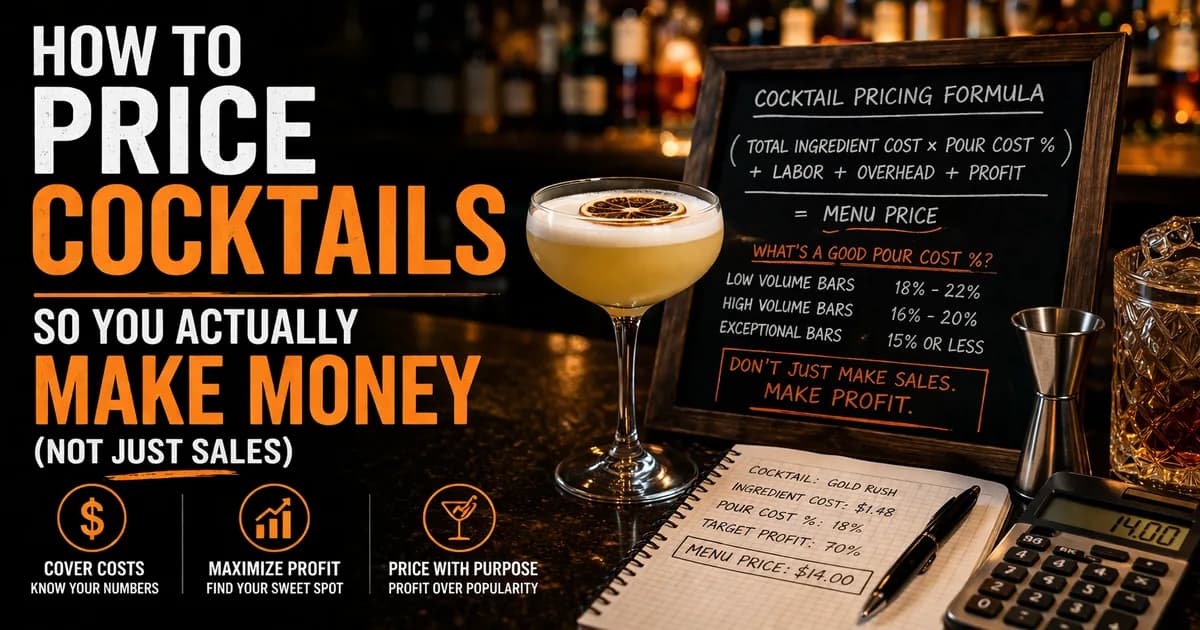
There are two ways to approach cocktail pricing, and you need both. The first gives you a floor, the minimum price you can charge without losing money. The second gives you a target based on the pour cost percentage your bar needs to stay profitable.
If a Negroni costs you $2.80 in ingredients and your target pour cost is 20%, the formula says you should charge $14.00. If your market supports $16, great. You are running at 17.5% pour cost on that drink and it is carrying the menu. If your market only supports $11, you are at 25.5% pour cost and that drink is working against you.
The formula does not make the decision for you. It just tells you what you are actually doing, which is more than most menus can say.
For bottle-level pricing before you build the full cocktail recipe, use the liquor markup guide to compare markup, target pour cost, and gross profit dollars on individual spirits.
How to Calculate Ingredient Cost Per Drink
Before you can price anything, you need the cost of every ingredient in the recipe. This means knowing your cost per ounce for every spirit, modifier, and mixer, not just the bottle price.
A standard 750ml bottle is 25.4 ounces. A 1-liter bottle is 33.8 ounces. A 1.75-liter handle is 59.2 ounces. Once you know your cost per ounce, multiply by the pour size for each ingredient and add them up.
Example: An Old Fashioned with 2 oz of $1.10/oz bourbon, a bar cherry at $0.15, and a half-orange peel at $0.10 costs $2.45 to make. Divide by your 20% target and your minimum price is $12.25.
- ▸Include every ingredient with a measurable cost: spirits, liqueurs, vermouth, fresh juice, syrups, garnishes.
- ▸Use your actual invoice cost, not the retail price.
- ▸Update ingredient costs when vendor prices change, even a 10% price increase on your well bourbon changes dozens of recipes.
- ▸Do not forget modifiers and bitters. A dash of Angostura is pennies, but Campari at 0.5 oz is real money.
What Pour Cost Target Should You Price To?
Your pour cost target is not the same as your current pour cost. It is the number you need to hit to run a profitable bar. For most full-service bars with cocktail programs, that target is 18 to 22% on spirits and cocktails. Beer and wine run higher by category.
- ▸Cocktails and spirits: aim for 18 to 22%
- ▸Draft beer: 20 to 26% is typical; higher-cost craft taps should aim tighter
- ▸Bottled and canned beer: 20 to 25%
- ▸Wine by the glass: 22 to 28%
- ▸Non-alcoholic drinks: price for value, not pour cost. Margins are naturally high
If you already know your overall pour cost percentage, you can use it to reverse-engineer which category is dragging you down. If spirits are at 24% but your overall is 28%, something else, usually wine or draft beer, is running hot.
If you need the category-level version of this math, use the bar beverage cost guide to separate liquor, beer, wine, mixers, waste, and variance before deciding which menu items need repricing.
Which Drinks Are Killing Your Margins Right Now
The fastest way to find your problem drinks is to run every item on your current menu through the formula and see what the math says. Sort by actual pour cost, highest to lowest. The drinks at the top of the list are either priced wrong, built wrong, or both.
Common patterns to look for:
- ▸House cocktails with expensive modifiers priced the same as simpler builds. A drink with Cointreau, fresh lime, and a float of Grand Marnier costs twice what a vodka soda costs to make.
- ▸Happy hour prices that were set years ago and never revisited after vendor price increases.
- ▸Signature drinks priced for promotion value instead of margin. Being known for a $9 craft cocktail is expensive.
- ▸Wine by the glass where the bottle cost went up but the glass price did not.
- ▸Shots and well pours that are priced below your pour cost target because they feel like commodity items.
How to Handle Drinks That Cannot Be Priced Correctly
Some drinks are worth running below your target pour cost because of the role they play. A loss-leader happy hour cocktail that fills seats Monday through Wednesday may generate more total revenue than raising the price and emptying the room. A signature drink that wins awards and drives covers may earn its keep at 25% pour cost.
The difference is knowing when you are making a deliberate decision and when you are just leaking money. If a drink is below your target, it should be there on purpose, with a reason and a plan, not because the menu was built without the math.
When to Reprice Your Menu
Most bars should review menu pricing at least twice a year. You should also reprice immediately when:
- ▸A key spirit in multiple cocktails goes up in price by more than 8 to 10%.
- ▸Your overall pour cost has been above target for two consecutive months.
- ▸You change a recipe spec and the ingredient cost shifts meaningfully.
- ▸A competitor in your market raises prices and your pricing now looks artificially low.
- ▸You add a new product or seasonal menu that has not been costed yet.
Repricing is not raising prices on everything. It is running the formula on the items that moved and adjusting the ones that are out of range. Most menus have three to five problem drinks causing most of the damage. You rarely need to touch everything at once.
How Tracking Inventory Makes Pricing Actually Work
Pricing your menu correctly gets you halfway there. The other half is making sure your team is building drinks to spec so the recipe cost you calculated is the recipe cost you are actually paying. A Margarita priced at $13 based on a 1.5 oz spec costs very different at 2 oz, and that difference does not show up until inventory.
BarGuard connects your recipes to your inventory counts so you can see the difference between theoretical usage (what your sales data says you should have used) and actual usage (what actually left your shelves). When those two numbers diverge on a specific item, it usually points to a recipe compliance problem, a pour size issue, or a shrinkage problem worth investigating.
The Bottom Line
Cocktail pricing is not art. It is arithmetic with a judgment call at the end. Run the formula for every drink, know which items are below target and why, and update your numbers when costs change. The bars that do this consistently are the ones that are still open in five years, and the ones whose profit margin holds up when costs rise.
If you want to make the recipe costing and variance tracking automatic, see how BarGuard ties your menu recipes to your inventory so you always know whether your pricing is holding up in practice.
The Cocktail Pricing Formula That Actually Protects Margin
The basic cocktail pricing formula is simple: total ingredient cost divided by target pour cost percentage equals menu price. If a drink costs $3.20 to make and your target pour cost is 20%, the menu price should be $16. But the formula only works if your ingredient cost is honest. That means using current bottle costs, exact recipe ounces, garnish cost, batch waste, and any premium modifier that changes the pour.
Most cocktail pricing mistakes happen before the formula. Bars use old invoice costs, ignore liqueurs and syrups, forget garnish, or price from memory because a competitor nearby charges the same. That can produce a menu that looks profitable but quietly bleeds margin every time a popular drink sells.
- 1Calculate the cost of every ingredient in the recipe.
- 2Add garnish, rim, syrup, juice, bitters, and batch components.
- 3Divide the total cost by your target pour cost percentage.
- 4Round to a menu-friendly price that fits your market.
- 5Check sales mix after launch so popular low-margin drinks do not drag down the whole program.
Example: Pricing a Margarita
Say your house margarita uses 2 oz tequila, 0.75 oz triple sec, 1 oz lime, 0.5 oz agave, and a salt garnish. If tequila costs $0.92 per ounce, triple sec costs $0.38, lime and agave together cost $0.42, and garnish adds $0.08, the drink costs roughly $2.72 before labor and waste. At a 20% pour cost target, the price is $13.60. Most bars would round that to $14.
If bartenders free-pour the tequila at 2.25 oz instead of 2 oz, the cost changes. That extra quarter-ounce may not sound like much, but it can move the drink from a healthy 19% pour cost to a weaker margin when multiplied across hundreds of drinks. Pricing and pour control are connected.
Do Not Price Every Cocktail With the Same Margin Rule
A single target pour cost is useful, but it should not flatten your whole menu. A high-volume house cocktail may deserve a sharper price because it sells often and anchors the menu. A premium spirit cocktail may carry a higher dollar cost but still produce strong gross profit. A signature cocktail with house-made prep may need a higher price because the hidden labor and waste are real.
- ▸Well and house cocktails: usually priced to hit the target pour cost tightly.
- ▸Premium cocktails: review gross profit dollars, not just percentage.
- ▸Batch cocktails: include batch loss, prep time, and spoilage risk.
- ▸Seasonal cocktails: review ingredient availability and waste before setting price.
- ▸Happy hour cocktails: price from a controlled recipe, not from a random discount.
How Often Should You Reprice Cocktails?
Review cocktail pricing any time bottle costs change, the menu changes, portion sizes change, or a drink becomes a top seller. At minimum, review the menu quarterly. Distributor price changes can quietly turn a profitable cocktail into a weak one, especially when tequila, whiskey, citrus, or specialty liqueurs move up in cost.
BarGuard helps with the control side of this problem by connecting recipes, POS sales, and inventory variance. Once you know what should have been used and what was actually used, you can see whether margin problems are coming from bad pricing, bad recipes, or actual product loss.
Pricing Mistakes That Make Good Cocktails Unprofitable
A cocktail can be popular and still hurt the business if the price ignores the real serving cost. The biggest mistakes are using the wrong pour size, pricing from competitors instead of cost, ignoring modifiers, and forgetting that citrus, syrups, rims, and garnishes change the math. A drink with fresh juice and a premium garnish may cost more than the liquor suggests.
Another mistake is failing to recheck popular drinks after launch. If bartenders adjust the build because guests complain it tastes weak, the true recipe has changed even if the menu file has not. The menu price should reflect the drink actually being served, not the drink that was written during menu planning.
- ▸Audit your top ten cocktails after the first two weeks on a new menu.
- ▸Compare POS sales to ingredient usage so popularity does not hide loss.
- ▸Watch doubles, rocks pours, premium substitutions, and happy hour versions separately.
- ▸Reprice when bottle cost, garnish cost, or recipe specs change.
The fastest way to check pricing on any item is the free pour cost calculator. Enter your bottle cost and pour size and get suggested menu prices at 20%, 25%, and 30% cost targets, a useful sanity check before you finalize a new menu or adjust prices mid-season.
BarGuard Catches What You Can't See
Connect your POS, count your inventory, and let BarGuard show you exactly where the gaps are, automatically, every week.