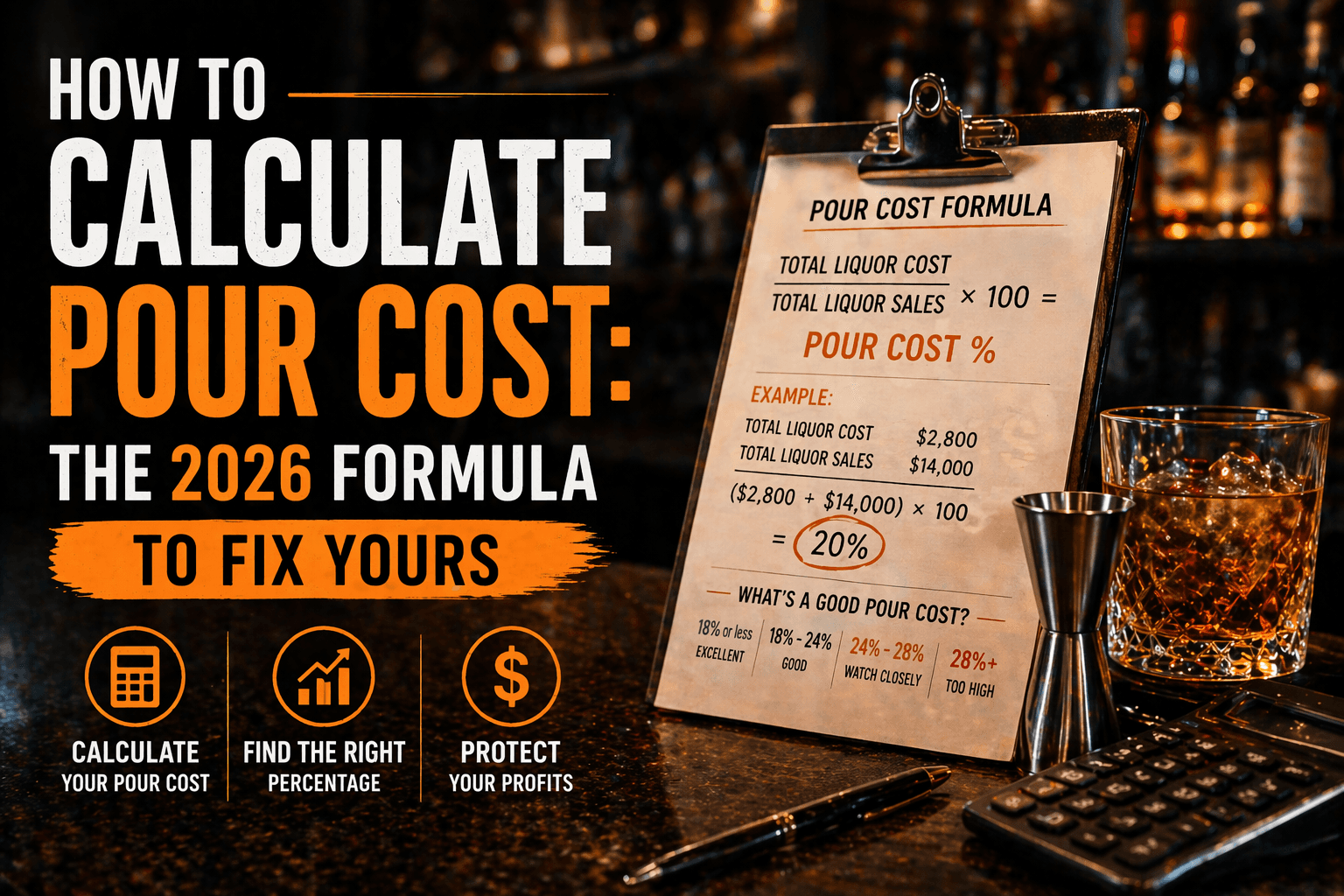
If you run a bar and you only ever track one number, make it pour cost. It tells you how much of every dollar in liquor sales is going back into paying for the product. When pour cost is healthy, your bar is probably profitable. When it is too high, you are losing money on every drink. You just might not know it yet.
Most bar owners know pour cost matters. Fewer know exactly how to calculate it, what a good number actually looks like by category, or what to do when the number comes back wrong. This guide covers all three.
Pour cost only becomes actionable when cost data is checked against sales mix. Toast's PMIX report documentation shows how item quantity, discounts, voids, COGS, gross profit, and gross margin can be displayed when POS data is configured for deeper review.
The Pour Cost Formula
Pour cost is calculated by dividing the cost of goods sold (COGS) by your total beverage revenue, then multiplying by 100 to get a percentage.
Here is a worked example. Say your bar bought $12,000 in liquor, beer, and wine last month and brought in $48,000 in beverage revenue. Your pour cost is ($12,000 ÷ $48,000) × 100 = 25%. That is within a healthy range for most bars.
Now say the same bar had $15,000 in COGS against the same $48,000 in revenue. Pour cost jumps to 31.25%, right at the industry average, which sounds acceptable until you realize it means you are spending $3,000 more per month on product than a well-run bar of the same size.
How to Calculate COGS Accurately
Your COGS figure is not just what you ordered this month. It is what you actually consumed. The correct formula is:
If you started the month with $8,000 in inventory, received $14,000 in deliveries, and ended with $10,000 on the shelf, your COGS is $12,000. That is the number that goes into the pour cost formula, not what you ordered, not what you paid on invoices, but what actually left your shelves.
This is why accurate inventory counts matter so much. A bad closing count corrupts your COGS, which corrupts your pour cost, which makes every decision you make based on that number wrong. If you are seeing pour cost swings of 5% or more month over month without any obvious cause, the first thing to check is count consistency.
What Is a Good Pour Cost Percentage?
There is no single universal target. Pour cost benchmarks vary by category, venue type, and price point. But here is a practical breakdown of what healthy looks like by product type:
- ▸Liquor: 18 to 22%, spirits carry the highest margin and should be your best-performing category.
- ▸Beer (draft): 20 to 26%, draft has higher waste and loss risk from kegs; well-run tap programs land around 22%.
- ▸Beer (bottled/canned): 20 to 25%, lower waste, easier to track, should perform close to spirits.
- ▸Wine: 28 to 35%, wine has a higher natural cost and more loss risk from opened bottles; targets are looser here.
- ▸Blended / total beverage: 20 to 28%, if your overall pour cost is consistently above 28%, you have a problem worth digging into.
High-volume, low-price bars (dive bars, sports bars) tend to run higher pour costs because margins are thin on individual drinks. Premium cocktail bars and wine bars often run lower because pricing absorbs the cost. Know your category before judging your number against a generic benchmark.
Theoretical vs. Actual Pour Cost
There are two versions of pour cost, and the gap between them is where the real insight lives.
Theoretical pour cost is what your cost should be if every drink was poured exactly to recipe, every comp was recorded, and nothing was wasted or stolen. You calculate it by multiplying your recipe cost per drink by the number of drinks sold. It tells you your floor.
Actual pour cost is what your COGS data and inventory counts show really happened.
If your theoretical pour cost is 22% and your actual is 29%, the 7-point gap is your problem. Every percentage point of that gap represents real money, over-poured drinks, unrecorded comps, theft, spillage, or bad counts. Identifying where the gap comes from is the entire point of pour cost tracking.
What Causes a High Pour Cost?
When your actual pour cost is higher than it should be, the cause usually falls into one of four buckets:
- 1Over-pouring, bartenders consistently pouring more than the recipe calls for, intentionally or not. A ¼ oz over-pour per drink across a busy week can cost $1,000 or more in lost margin. See our breakdown of <a href="/blog/over-pouring-bar-losses">how much over-pouring costs your bar</a>.
- 2Theft, product leaving the building without being rung up. This shows up in variance but gets hidden if counts are inconsistent or infrequent.
- 3Waste, spilled drinks, over-prepared batches, spoiled kegs, and returns that never get documented. These are real costs that belong in your COGS but often get attributed to a mystery.
- 4Unrecorded comps, staff giving drinks on the house without entering them as comps in the POS. The product is gone. Revenue is not recorded, and pour cost looks artificially high.
The reason tracking pour cost by category matters is that different causes show up in different places. If your liquor pour cost is fine but beer is 10 points high, the problem is probably a keg line issue, draft waste, or inconsistent keg counting, not your bartenders free-pouring spirits.
How Often Should You Calculate Pour Cost?
Monthly is the minimum. Weekly is better. The faster you catch a pour cost problem, the fewer shifts it has to compound.
A bar that catches an over-pouring problem after one week loses one week of margin. A bar that catches it at the monthly accounting review loses four weeks. At scale, that difference is often the gap between a profitable month and a loss.
If you are tracking pour cost weekly, you can correlate spikes to specific shifts, specific staff, specific events, or specific products. That context is what turns a number into an action. A monthly pour cost figure just tells you something went wrong. It rarely tells you what or when.
When pour cost looks high but usage is clean, the next place to check is price. The liquor markup formula helps translate bottle cost and pour size into a selling price that protects margin without relying on guesswork.
How to Bring Your Pour Cost Down
If your pour cost is higher than it should be, the fix depends on the cause. Here is where to start:
- ▸Standardize recipes and train to them. Every drink should have a defined pour size, and every bartender should know it. Jiggers are the most reliable tool for enforcing this without confrontation.
- ▸Run variance after every count. Compare what your POS says you should have used to what inventory shows you actually used. A variance report identifies the specific product driving the problem.
- ▸Track comps formally. Every comped or spilled drink should be entered in the POS. This keeps your actual pour cost honest and gives managers visibility into where product is being given away.
- ▸Count more frequently. Pour cost accuracy depends on inventory accuracy. Weekly counts give you weekly pour cost. Monthly counts give you a number that already has four weeks of drift baked in.
- ▸Review pricing. Sometimes pour cost is high because menu prices are set against old product costs. If your cost of goods has increased but menu prices have not moved, pour cost rises with no operational failure at all.
Tracking Pour Cost Without a Spreadsheet
Most bar owners who track pour cost manually end up with inconsistent data. The calculations are not difficult. The problem is that everything depends on clean inventory counts, accurate purchase records, and POS data that is entered correctly. When any one of those inputs is off, the pour cost figure is off, and the decision you make based on it is wrong.
Bar management software solves this by connecting your inventory counts, purchase entries, and POS sales data into a single calculation. Instead of pulling three spreadsheets together at the end of the month, you see your pour cost updated after every count by category, by product, and with variance already flagged. For the broader operating workflow, see the bar cost control software guide.
BarGuard calculates your actual and theoretical pour cost automatically after each inventory cycle, flags the products where your actual usage is outrunning your theoretical, and lets you drill into individual count cycles to see exactly when the gap opened. If you want to see how it works, start a free trial.
The Bottom Line
Pour cost is not a complicated concept, but it is one that most bars calculate too infrequently, too inaccurately, or not at all. The formula is simple: COGS divided by beverage revenue. The hard part is getting clean inputs and reviewing the number often enough to catch problems before they become expensive.
A healthy bar targets 18 to 24% overall pour cost and tracks it at least weekly. When the number creeps up, the gap between theoretical and actual pour cost points you directly to the cause. Fix the cause, and the number comes down, along with the losses that were hiding behind it.
Pour Cost vs Variance: Why You Need Both
Pour cost tells you how much product cost you used compared with beverage revenue. Variance tells you whether the amount used matched what your POS and recipes expected. You need both because pour cost alone can hide the reason behind the number. A high pour cost may come from underpriced cocktails, rising bottle costs, over-pouring, theft, waste, or a sales mix shift toward premium products.
Variance narrows the investigation. If pour cost is high but variance is clean, review pricing, recipe costs, discounts, and sales mix. If pour cost is high and variance is high, review usage controls first. This prevents managers from changing menu prices when the real issue is product disappearing without a matching sale.
A Practical Pour Cost Review Checklist
- ▸Use current invoice costs, not last year's bottle prices.
- ▸Separate spirits, beer, wine, and cocktail batches so one category does not hide another.
- ▸Compare actual usage against expected usage before changing prices.
- ▸Review discounts, comps, voids, and promos because revenue changes the percentage.
- ▸Watch top sellers first because they move the total fastest.
The most useful pour cost review is short and regular. Run it weekly for high-volume categories and monthly for the full beverage program. If you wait until the end of the quarter, the loss has already happened and the shift-level detail may be gone.
Pour Cost Example With Real Numbers
Imagine your bar starts the week with $14,000 in liquor inventory, receives $5,000 in purchases, and ends the week with $13,200 in liquor inventory. Actual liquor used is $14,000 plus $5,000 minus $13,200, or $5,800. If liquor sales for the same week were $25,000, liquor pour cost is $5,800 divided by $25,000, which equals 23.2%.
That number is useful, but it is only the beginning. If your target is 20%, the next question is why the bar landed at 23.2%. Did supplier costs rise? Did bartenders over-pour? Were comps recorded correctly? Did a popular premium cocktail sell more than usual? Did purchases get entered in the right week? The formula tells you the result. Inventory variance explains the cause.
How to Improve Pour Cost After You Calculate It
- 1Review the highest-volume products first.
- 2Check whether recipe costs match current invoice costs.
- 3Compare actual usage to expected usage from POS sales.
- 4Fix over-pouring and waste before raising prices.
- 5Reprice menu items only after the usage data is clean.
Common Pour Cost Calculation Errors
The formula is easy, but the inputs are often messy. Make sure purchases are in the correct period, inventory counts are taken at the same time each cycle, and revenue includes the right sales category. If food revenue or tax is mixed into beverage sales, the percentage will look artificially low. If comps and discounts are ignored, the percentage may not reflect the real revenue collected.
Also watch bottle cost changes. If your spreadsheet still uses an old tequila cost, every pour cost calculation for that item is wrong. Current invoice costs matter because pricing decisions depend on the real cost of the drink today, not what it cost when the menu was first written.
If you want to skip the math and check your numbers instantly, use the free BarGuard pour cost calculator. Enter your bottle cost, bottle size, and pour size and get your cost per pour, pour cost percentage, and suggested menu prices at 20%, 25%, and 30% targets, no spreadsheet required.
Frequently Asked Questions
What is a good pour cost percentage for a bar?
A healthy pour cost depends on the category. Target 18 to 22% for spirits, 20 to 26% for draft beer, 20 to 25% for bottled beer, and 28 to 35% for wine. A blended overall pour cost of 20 to 28% is typical for a well-run bar.
What is the pour cost formula?
Pour Cost % = (COGS ÷ Beverage Revenue) × 100. COGS is calculated as: Opening Inventory + Purchases − Closing Inventory. Divide that number by total beverage revenue for the same period and multiply by 100 to get your pour cost percentage.
How do I lower my pour cost percentage?
Start by comparing your actual pour cost to your theoretical pour cost (what it should be based on recipes and pricing). The gap reveals where loss is happening, over-pouring, waste, theft, or mispriced menu items. Tighten recipes, train on consistent pour sizes, and audit your highest-volume items first.
What is the difference between pour cost and liquor cost?
The terms are often used interchangeably. Both refer to the cost of alcohol as a percentage of the revenue it generates. Pour cost is the more precise term. It refers to the cost per pour relative to the sell price. Liquor cost typically refers to the same ratio applied to spirits specifically.
How often should I calculate pour cost?
At minimum, calculate pour cost at the end of each inventory period, typically weekly or bi-weekly. Monthly is the floor for any bar trying to control shrinkage. Higher frequency gives you faster feedback and makes variance easier to trace to specific shifts or staff.
BarGuard Catches What You Can't See
Connect your POS, count your inventory, and let BarGuard show you exactly where the gaps are, automatically, every week.