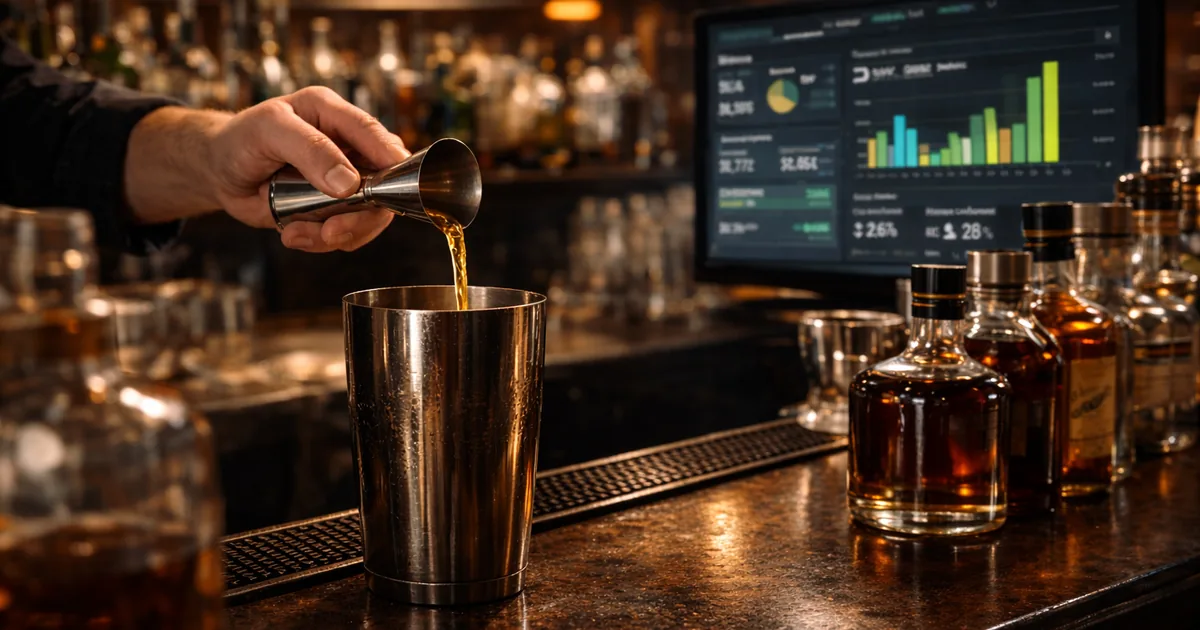
If you run a bar, you already know this number matters. Your liquor cost percentage can make or break your profitability.
But here's where most bar owners go wrong. They try to fix it by cutting quality, raising prices randomly, or blaming staff without actually knowing what is happening behind the bar. And none of that fixes the real issue.
What Is Liquor Cost Percentage
Liquor cost percentage is calculated like this: Cost of Liquor Used ÷ Liquor Sales × 100. If you spend $3,000 on liquor and generate $10,000 in sales, your liquor cost is 30%.
Liquor cost control depends on pairing cost data with sales mix. Toast's PMIX report documentation shows how POS reporting can include item quantity, average price, discounts, voids, COGS, gross profit, and gross margin when those fields are configured.
Why Your Liquor Cost Is Too High
Overpouring
Even a small overpour adds up fast. An extra quarter ounce per drink across a busy night can turn into hundreds, or even thousands, in lost revenue. When combined with bartender theft, the gap between expected and actual usage widens even faster.
No Real Inventory Tracking
If you are counting inventory once a week, you are already behind. You are not seeing where the loss is happening, only that it already happened.
Inconsistent Recipes
If every bartender pours differently, your margins become unpredictable. Without standard recipes, there is no control.
Untracked Waste and Free Drinks
Spills, comps, and hookups rarely get tracked. But they still hit your bottom line the same as any other loss.
The Smarter Way to Reduce Liquor Cost
You do not fix liquor cost by guessing. You fix it by gaining visibility.
Track Expected vs. Actual Usage
Instead of just counting bottles, you need to compare what should have been used versus what was actually used. This is called variance tracking. BarGuard runs shift-based calculations that show expected usage, actual usage, variance, and estimated loss in dollars, so the real problem becomes clear immediately.
Standardize Every Drink
Every drink should have a defined recipe with exact measurements. No guessing. No freestyle pouring. Consistent recipes are what make your cost projections accurate. Recipes only hold up when the counts behind them do, which is the job of liquor inventory management.
Count Inventory More Frequently
Weekly counts are not enough for high-risk items. The faster you catch variance, the less money you lose, and the easier it is to trace the cause.
Focus on High-Risk Items First
Not every bottle matters equally. Focus on high-volume and high-cost items first. BarGuard highlights critical and warning items automatically so you know exactly where to look.
Use Data to Manage Your Staff
Instead of guessing who is overpouring, you will start seeing patterns. Certain shifts or items will consistently show higher variance. Now you can coach your team with real data instead of assumptions.
What Happens When You Fix This
- ▸Your margins increase immediately
- ▸Waste drops across every category
- ▸Staff becomes more consistent with real accountability
- ▸You stop guessing your numbers and start running your business with confidence
Where BarGuard Fits In
BarGuard was built to solve this exact problem. It gives you real-time inventory tracking, variance analysis, and full visibility into where your money is going. Instead of wondering why your liquor cost is high, you will know exactly what is causing it.
Learn more about how it works on our how it works page, or compare plans on our pricing page.
The Bottom Line
Most bars do not have a pricing problem. They have a control problem. Fix the control and your liquor cost follows, and you will see the improvement immediately in your bar profit tracking and overall bar profit margin.
Start by Separating Price Problems From Usage Problems
Liquor cost percentage can rise for two very different reasons: the product costs more, or the bar is using more product than it should. Those require different fixes. If distributor prices increased, you may need menu adjustments, vendor negotiation, or recipe changes. If usage is higher than expected, the issue is over-pouring, waste, theft, comps, training, or bad recipes.
This is why looking only at total liquor cost is dangerous. A 27% liquor cost may look like a pricing problem, but if your POS and recipes show expected usage should have been $8,000 and actual usage was $10,000, the first lever is loss control. Raising prices without fixing usage just asks guests to subsidize a broken process.
Seven Ways to Reduce Liquor Cost Without Cheapening the Guest Experience
- 1Standardize recipes so every bartender pours the same drink.
- 2Use jiggers or measured pour systems on drinks with repeated variance.
- 3Review top-selling cocktails monthly against current invoice costs.
- 4Track expected-vs-actual usage so over-pouring is visible by item.
- 5Reduce dead stock by tightening par levels on slow movers.
- 6Control comps, shift drinks, and manager giveaways with clear POS buttons.
- 7Train bartenders on gross profit, not just speed and hospitality.
None of these steps require watering down drinks or buying worse product. The goal is to sell the drink the guest ordered at the recipe the business priced. A generous pour feels friendly in the moment, but if it is not priced, recorded, or approved, it is margin leaving the bar.
Use Variance to Find the Real Cost Leak
The fastest way to reduce liquor cost percentage is to stop chasing the average and find the items doing the damage. Sort variance by dollar impact. If vodka, tequila, and bourbon account for most of the loss, do not spend manager time debating slow-moving cordials. Fix the products that move the profit line.
Variance also tells you whether a cost issue is broad or specific. Broad variance across many spirits may point to free-pouring culture, weak controls, or missing purchases. Specific variance on one item may point to a recipe, a popular cocktail, a theft pattern, or an item entered under the wrong unit size.
- ▸One item, one shift: investigate behavior, comps, or theft.
- ▸One item, every shift: check recipe, glassware, and POS mapping.
- ▸One category, many shifts: review training, jigger use, and portion standards.
- ▸All categories: check purchase entry, count timing, and inventory process quality.
Do Not Ignore Sales Mix
Liquor cost percentage is affected by what guests buy. If your menu pushes low-margin premium pours, your percentage may rise even if bartenders are doing everything right. That does not automatically mean the program is unhealthy. A premium drink can have a higher cost percentage and still generate more gross profit dollars than a cheap well drink.
Review margin by menu item, not only by category. If a popular cocktail has weak profit, adjust the recipe, price, portion, or menu placement. If a drink has strong margin but low sales, train the team to recommend it or move it into a better menu position.
A 30-Day Liquor Cost Reduction Plan
- 1Week 1: clean item names, recipe specs, purchase entry, and count timing.
- 2Week 2: review top 20 products by sales volume and variance dollars.
- 3Week 3: retrain pours, correct recipes, and tighten comp/waste recording.
- 4Week 4: compare new variance and pour cost against the baseline.
BarGuard makes this plan easier because it connects POS sales, recipes, counts, and purchases. Instead of waiting for end-of-month accounting, managers can see where liquor cost is drifting while there is still time to correct it.
Fix Comp, Void, and Waste Recording First
Before changing vendors or rewriting the menu, make sure every non-sale movement is recorded. Comps, voids, shift drinks, tastings, broken bottles, training pours, and kitchen transfers all remove product from inventory. If they are not recorded, they show up as mysterious usage and make liquor cost look worse than it is.
Create clear POS buttons and manager rules for each type of movement. A guest recovery comp is different from a bartender mistake. A broken bottle is different from a training pour. The accounting does not need to be complicated, but it does need to be consistent enough that managers can separate normal business activity from uncontrolled loss.
Train Bartenders on the Business Reason Behind Pour Standards
Bartenders are more likely to follow pour standards when they understand why the standard exists. A quarter ounce over-pour on one drink feels harmless. A quarter ounce over-pour across hundreds of weekly cocktails becomes bottles of unpaid product. Training should connect the pour standard to guest consistency, menu pricing, and the ability to keep good products on the shelf.
This does not mean treating the bar team like suspects. It means making the standard clear, measurable, and fair. If every bartender is expected to hit the same recipe, variance data becomes a coaching tool instead of a guessing game.
Tighten Purchasing Without Starving the Bar
Reducing liquor cost is not the same as under-ordering. Running out of top sellers costs sales and frustrates guests. The better move is to tighten par levels based on actual usage. High-volume products need enough safety stock. Slow movers should not tie up cash just because someone once thought they might sell.
- ▸Set par levels from weekly usage, not habit.
- ▸Review dead stock monthly and remove products that do not earn shelf space.
- ▸Compare supplier price changes against menu pricing before the margin disappears.
- ▸Use emergency purchases as a signal that pars or ordering cadence may be wrong.
What a Healthy Liquor Cost Review Meeting Looks Like
Keep the meeting short and specific. Review category liquor cost, top variance dollars, top sales items, comp and waste totals, and any supplier cost changes. Then choose the three actions most likely to improve next week. The meeting should produce decisions, not just observations.
- 1Confirm the numbers are clean: purchases entered, counts complete, recipes current.
- 2Identify the products causing the largest dollar impact.
- 3Decide whether the issue is pricing, usage, purchasing, or recording.
- 4Assign one owner and one deadline for each corrective action.
- 5Check the same products again on the next count cycle.
How Low Should Liquor Cost Percentage Be?
There is no universal target that fits every concept. A cocktail bar with fresh ingredients, premium spirits, and complex recipes may operate differently than a beer-and-shot neighborhood bar. Many operators aim for spirits in the high teens to low twenties, but the healthier benchmark is your own trend. If the bar was running 21% and now runs 27%, the change deserves investigation even if another venue would accept that number.
Do not chase a low percentage at the expense of guest experience. Under-pouring, cheap substitutions, and aggressive price hikes can damage the brand. The goal is controlled consistency: the guest receives the recipe you promised, the bartender follows the spec, and the business earns the margin it planned.
How BarGuard Helps Lower Liquor Cost Over Time
BarGuard does not lower liquor cost by guessing. It lowers liquor cost by making the controllable problems visible. When counts, recipes, purchases, and POS sales are connected, the system can show which products are above expected usage and what that variance costs. Managers can then focus on the few items that actually move the number.
That visibility also creates accountability without turning management into a witch hunt. If variance improves after recipes are corrected, the problem was process. If variance only appears on certain shifts or certain bottles, the review can be more targeted. Either way, the bar stops waiting for the monthly P&L to find out money already left the building.
The practical target is steady improvement. If you reduce repeated variance on the highest-volume bottles, record waste honestly, and keep menu prices aligned with current costs, liquor cost percentage usually moves in the right direction without cheapening the program. That is the kind of margin improvement owners can defend because it comes from control, not shortcuts.
Use the first month as the baseline, not the finish line. Once the team sees which products drive the loss, the next month should show cleaner counts, fewer unexplained variances, and more confident pricing decisions across every bar shift, inventory count, and menu update cycle for lasting profit control across the full beverage program.
Before adjusting prices or renegotiating recipes, run the numbers on your highest-volume items using the free pour cost calculator. It gives you cost per pour and suggested menu prices at 20%, 25%, and 30% targets, a useful starting point before you build out the full variance picture in BarGuard. See the bar cost calculator hub for every cost tool in one place.
Frequently Asked Questions
What is a good liquor cost percentage for a bar?
A healthy liquor cost percentage (also called pour cost) is 18 to 22% for spirits, 20 to 26% for draft beer, and 28 to 35% for wine. A blended beverage cost across all categories typically targets 20 to 28%. Anything consistently above these ranges suggests over-pouring, theft, or pricing that does not cover costs.
How do I reduce liquor cost percentage at my bar?
The fastest levers are: require jiggers to eliminate free-pouring variance, update menu prices based on actual ingredient costs, audit your highest-volume products for over-depletion first, and compare theoretical pour cost to actual pour cost weekly to pinpoint where the gap is widening.
Does reducing liquor cost percentage increase profit?
Yes, directly. If your beverage revenue is $50,000/month and you reduce pour cost from 28% to 23%, you retain an additional $2,500 in gross margin per month, $30,000 annually, without changing your sales volume. Liquor cost is one of the highest-leverage numbers in a bar's financials.
What causes a high liquor cost percentage?
Common causes: free-pouring without jiggers, over-sized portions on high-cost cocktails, menu prices set too low relative to ingredient costs, unrecorded waste and comps, theft, and outdated recipes that no longer reflect current ingredient prices.
BarGuard Catches What You Can't See
Connect your POS, count your inventory, and let BarGuard show you exactly where the gaps are, automatically, every week.