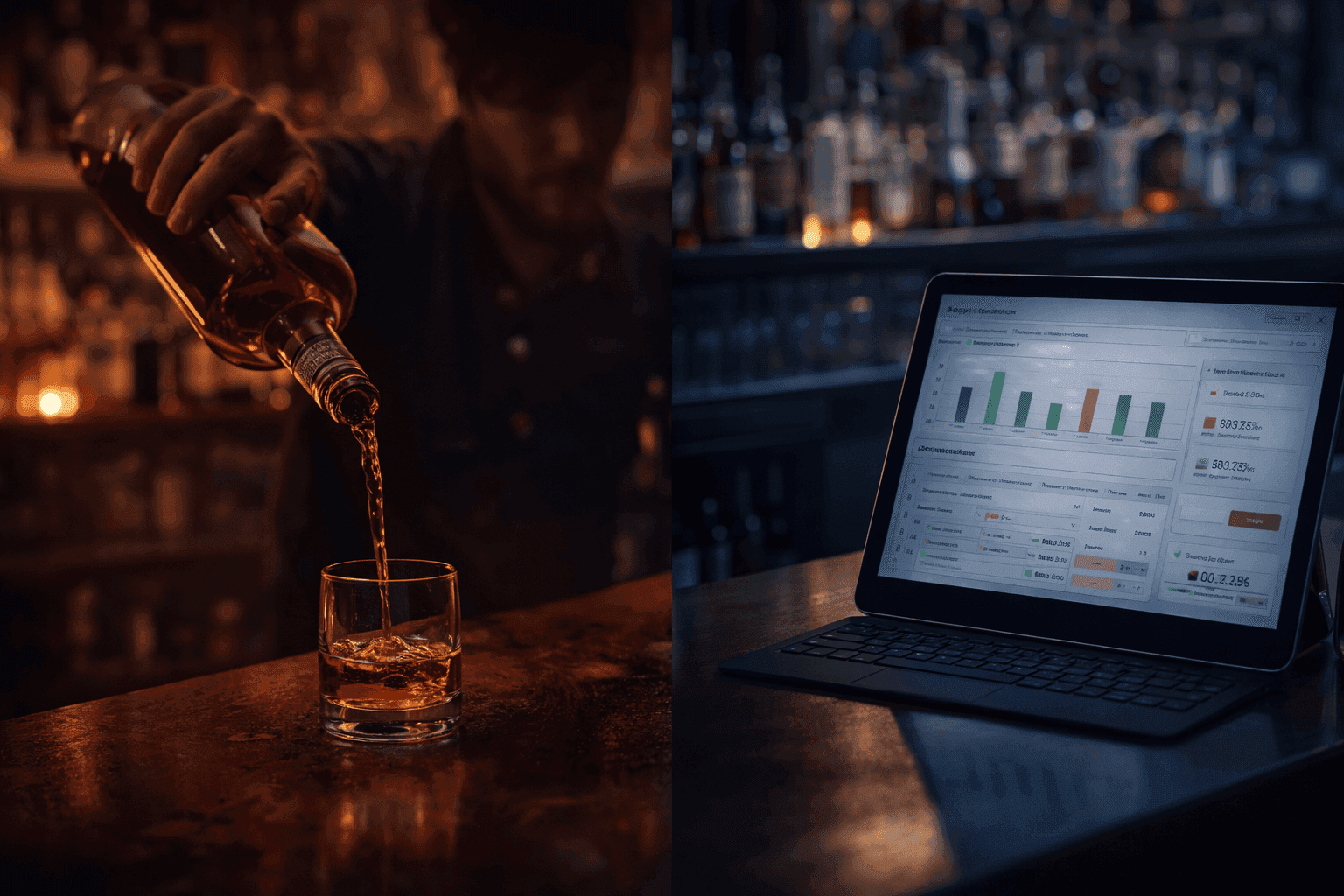
Most bar owners don't realize they have a theft problem until it's already costing them thousands. And the worst part? It rarely looks like theft. It looks like inventory that doesn't add up, revenue that should be higher, and bottles running dry faster than your sales justify. If you've ever felt like something is off but couldn't prove it, you're not alone — and you're probably right.
What Bartender Theft Actually Looks Like
Forget the idea of someone stuffing bottles in a bag. Real bartender theft is subtle, consistent, and specifically designed to avoid detection. It doesn't show up as a dramatic event — it shows up as patterns that slowly erode your margins over weeks and months.
1. Intentional Overpouring
A bartender pours slightly more than the standard on every drink — not to pocket cash, but to win tips, build loyalty with regulars, or simply as habit. Half an ounce over per drink doesn't sound significant. Across 100 drinks on a Friday night, that's 50 ounces of product gone without a corresponding sale. Multiply that by 30 nights and you've lost 1,500 ounces — the equivalent of more than 40 standard 750ml bottles — in a single month from overpouring alone.
2. Free Drinks and Sweethearting
This is the most common form of theft that bar owners underestimate. A round gets poured for a group of friends. Nothing gets rung up. The bartender pockets nothing — but your inventory takes the hit and your revenue doesn't reflect the sale. Sweethearting thrives because it feels like hospitality rather than theft, to the bartender and often to ownership. The tell: usage-to-sales variance climbs on certain shifts, even when cash overages are rare.
3. Short Ringing
Four drinks get ordered. Three get rung up. The cash for the fourth goes into a pocket. Done fast and consistently, this is nearly invisible to customers and to managers who aren't cross-referencing POS sales against inventory consumption. The tell: cash sales run consistently lower than volume would suggest, specifically on certain shifts or at certain stations.
4. Inventory Count Manipulation
The most dangerous scenario: a bartender or manager who also runs inventory counts can manipulate numbers to bury ongoing losses. They count high on items they're stealing to keep variance invisible. The tell: suspiciously clean variance reports, especially when the same person conducts every count cycle. The fix is simple — the person doing the counting should never be the person pouring the drinks.
Why Most Bar Owners Miss It
The biggest problem isn't theft itself — it's visibility. Most bars rely on manual inventory counts done inconsistently, spreadsheets that track what you have but not what you should have, and gut feeling that something seems off. None of those tools answer the one question that actually matters: what should have been used versus what actually was used?
That gap between theoretical usage and actual usage is exactly where theft, overpouring, and untracked comps hide. Without a system that calculates it automatically, you're essentially relying on criminals to flag their own behavior.
How to Catch Bartender Theft Early: A Four-Step System
Step 1: Count Inventory on a Consistent Schedule
You cannot manage what you don't measure. Weekly counts are the industry standard for bars that take shrinkage seriously. Daily counts by category for your highest-velocity items — your top five spirits and top-selling beers — will catch problems faster and make it harder for patterns to hide across a full week.
- ▸Count opening and closing inventory for every shift if you suspect active theft.
- ▸Use the same counting method and the same sequence every time — inconsistency creates its own noise.
- ▸Keep counts separate from the bartenders who worked that shift.
- ▸Record everything — partial bottles included — so you're not estimating.
Step 2: Define Standard Recipes and Pour Sizes
Every drink on your menu should have a defined recipe with precise pour amounts. No guessing, no "free pouring to feel." Consistency is what makes problems visible. When every bartender pours 1.5 oz of well whiskey, a variance that shows 1.9 oz consumed per drink sold is a red flag you can act on. Without that baseline, all you have is a hunch.
Step 3: Monitor Variance — Expected vs. Actual
This is the step that changes everything. Instead of asking "where did the liquor go?" you start asking "why did we use more than we should have?" Variance is calculated by comparing theoretical usage — what your POS says you should have consumed based on drinks sold — against actual usage from your physical inventory counts.
A shrinkage rate under 10% is the industry benchmark for a well-run bar. If your variance is consistently above 15% on specific items, you have a data point — not a suspicion. That data point is something you can act on, and something that will hold up in a conversation with staff.
Step 4: Look for Patterns, Not One-Off Events
One bad shift doesn't mean theft — it might mean a spill, a busy night, or a training gap. But repeated patterns do mean something. The most important signals to track:
- ▸The same inventory items showing high variance week over week.
- ▸Variance that spikes on specific shifts — not random nights.
- ▸The same staff members consistently tied to high-variance sections.
- ▸Cash sales running lower than volume would suggest on particular stations.
- ▸Void and comp rates that are higher for specific employees than the team average.
When you're tracking variance systematically, patterns like these become visible in days rather than months. The 18-month average detection window shrinks dramatically when you have weekly data in front of you.
The Real Cost of Ignoring It
Even modest theft and overpouring compound fast. Consider a single bartender consistently overpouring by half an ounce per drink across a 100-drink shift, 30 nights a month. That's 1,500 ounces of lost product — the equivalent of more than 40 bottles of mid-shelf spirits. At $18 cost per bottle, that's $720 in product cost. At a typical 22% pour cost ratio, that represents roughly $3,270 in lost potential revenue every month from one behavior at one station.
Add a few free rounds per shift, one bottle walked per week, and a cash pocket here and there — and you're looking at $5,000–$8,000 in monthly losses that never show up as a line item anywhere. It shows up as pour cost that's "a little high" and margins that never seem to improve no matter how busy you get.
How BarGuard Helps You Stop Bartender Theft
BarGuard was built specifically to eliminate the visibility gap that lets bartender theft survive. Instead of relying on gut feeling or inconsistent manual tracking, you get a system that calculates exactly what should have been used — and flags where it wasn't.
- ▸Automatic variance tracking: expected vs. actual usage calculated every count cycle.
- ▸Item-level breakdown — see which spirits, beers, or wines are showing the highest discrepancies.
- ▸Shift-based insights that help you identify when losses are happening, not just that they are.
- ▸AI-generated summaries that explain what the data means in plain language.
- ▸Alerts for high-risk items before a small variance becomes a large one.
This isn't inventory software with a shrinkage calculator bolted on. It's a loss detection system designed around how bars actually operate — built to surface the patterns that manual tracking misses entirely. See how BarGuard helps bars stop bartender theft and take back control of their margins.
Frequently Asked Questions About Bartender Theft
How common is bartender theft?
Industry studies consistently find that internal employee theft accounts for 35–40% of all bar shrinkage. The National Restaurant Association estimates that theft costs the hospitality industry over $6 billion annually. Most of it happens in small, repeated increments — not in dramatic, easily-caught events.
Can you fire someone for bartender theft without proof?
Employment law varies by state and country, but a documented pattern of inventory variance tied to specific shifts and employees — combined with POS data showing cash discrepancies — is generally considered credible grounds for termination. Consult your HR or legal advisor before acting, but data is almost always stronger than accusation alone.
What is the fastest way to detect bartender theft?
The fastest method is systematic variance tracking: count inventory consistently, define your recipes and standard pours, pull your sales data, and compare what should have been used to what was actually used. If you do this weekly by item and by shift, patterns that would otherwise take 18 months to detect become visible within 2–4 counting cycles.
BarGuard Catches What You Can't See
Connect your POS, count your inventory, and let BarGuard show you exactly where the gaps are — automatically, every week.