Most bar owners think their biggest losses come from theft. They're wrong.
One of the biggest silent killers of bar profits is something much harder to notice: overpouring. It doesn't look like a problem in the moment. It feels like good service. It even keeps customers happy. But over time, it quietly drains thousands of dollars from your business.
What Is Overpouring?
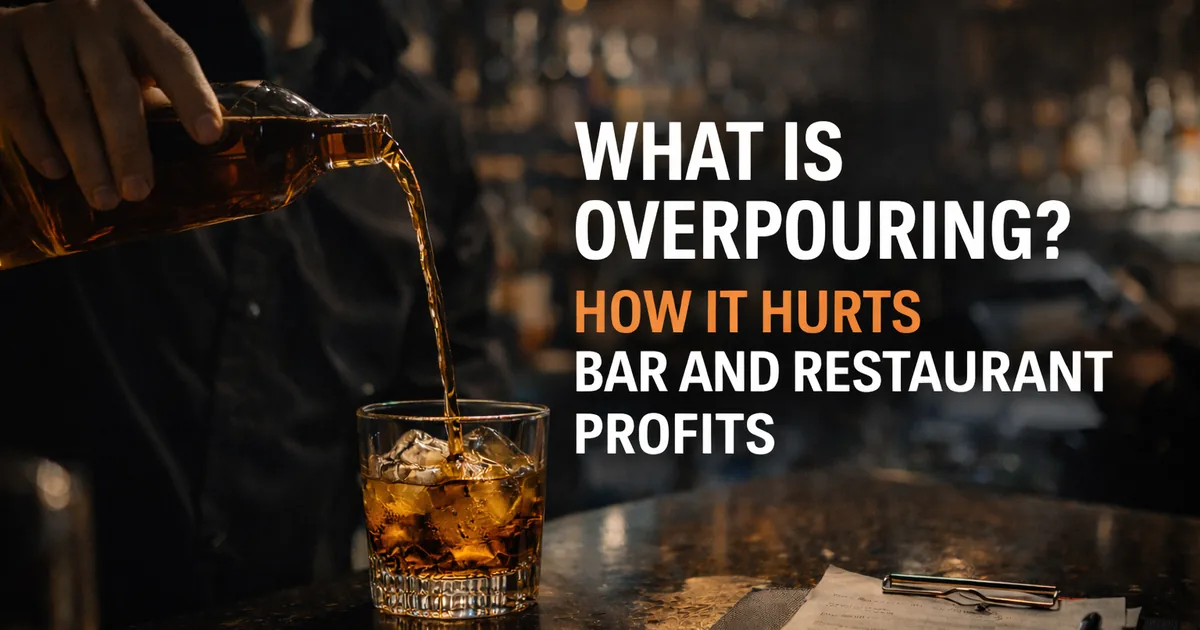
Overpouring is when a bartender serves more alcohol than the standard portion for a drink. For example: a standard pour is 1.5 oz, but the bartender pours 2 oz. That extra 0.5 oz might not seem like much, but multiply it across hundreds of drinks per night, multiple bartenders, and weeks or months of service.
The cleanest way to investigate overpouring is to compare measured usage with POS sales activity. Toast's menu reports overview describes item, modifier, menu group, and 86 reporting that can help operators understand what should have moved during a count period.
It becomes a serious financial leak that most bar owners never trace back to its source.
Why Overpouring Happens
Overpouring is not always intentional. In fact, most of the time it is not. Here are the most common causes.
Free Pouring Without Measurement
Bartenders relying on speed and instinct instead of jiggers or measured systems are the most common source of overpours. A trained bartender can free-pour within 5% accuracy. An untrained one can be 30 to 40% off without knowing it, and that gap hits your bar profit directly.
Trying to Hook Up Customers
Extra alcohol given to regulars, friends, and big spenders feels like hospitality. From the bartender's perspective, it builds tips and loyalty. From yours, it's product given away that never hits the register, and it compounds with every shift.
Poor Training
New staff not properly trained on standard pour sizes and drink consistency will overpour by default. If no one shows them what 1.5 oz looks like in practice, every drink is a guess.
No Accountability
If no one is tracking usage against sales, there is nothing stopping overpouring from happening every shift. Visibility is the only real deterrent.
How Overpouring Hurts Your Profits
This is where it gets serious. Let's break down the math.
A 750ml bottle contains roughly 25 oz. At a standard pour of 1.5 oz, that's about 16 drinks per bottle. If bartenders pour 2 oz instead, you only get 12 drinks per bottle. That is a 25% loss in revenue per bottle. Now apply that across a high-volume night with premium liquor and multiple bartenders, and you could be losing thousands per month without realizing it.
Overpouring vs Bartender Theft
A lot of owners confuse these two problems. Here is the difference: overpouring is usually unintentional but still costly, while bartender theft is deliberate misuse or product giveaway. But here is the uncomfortable reality: both show up the same way in your numbers. You just see inventory missing and sales not matching usage.
That is why tracking is everything. Without the data, you cannot tell which one you are dealing with, or whether it is both at the same time.
How to Detect Overpouring
You cannot fix what you cannot see. The only reliable way to catch overpouring is by comparing what should have been used versus what was actually used. This is called variance tracking, and it is exactly how systems like BarGuard work.
- ▸Sales data tells you what drinks were sold
- ▸Recipes define how much liquor should have been used per sale
- ▸Inventory counts show what is actually missing
- ▸The gap between expected and actual usage is your variance, and your loss number
From there, you can calculate variance per item, per shift, and per category, and spot the problem immediately instead of months down the line.
How to Prevent Overpouring
1. Standardize Your Recipes
Every drink should have defined ingredients and exact pour sizes. Without a recipe, every pour is a guess. With one, you have a baseline for what every drink should cost, and a benchmark for catching when it does not.
2. Train Your Staff Properly
Make sure bartenders understand why pour accuracy matters and how it impacts the business. The bars that make the fastest progress are the ones where staff can see the connection between their pours and the profit margin.
3. Use Measured Pouring Tools Where Needed
Jiggers or controlled pourers help maintain consistency, especially during rush periods when free-pour accuracy breaks down the most. Many craft bars have reframed jigger use as quality-focused rather than distrust-signaling.
4. Track Inventory Regularly
Manual counts alone are not enough. You need a system that shows expected versus actual usage and flags real-time variance, so you know which items, which shifts, and which stations are running heavy. That is where the pattern becomes actionable.
The Real Fix: Visibility
Overpouring is not a discipline problem. It is a visibility problem. When you can clearly see which bottles are losing money, which shifts have the highest variance, and which items are being overused, everything changes. Staff becomes more aware. Managers make better decisions. Profit stops leaking.
The fastest path to fixing it is variance-based tracking that runs automatically after every count cycle, not a spreadsheet you build once and never trust again. That visibility also feeds directly into your ability to reduce your liquor cost percentage to a target range and hold it there.
Want to Stop Losing Money to Overpouring?
If you want to take control of your inventory and stop profit loss at the source, see how BarGuard tracks and controls inventory in real time, with variance reporting that shows you exactly where overpouring is happening and what it is costing you.
Overpouring might seem small in the moment, but over time it adds up to one of the biggest hidden losses in your bar. The difference between a profitable bar and a struggling one often comes down to control, consistency, and visibility. Fix those, and you fix your margins. A tighter operation also makes it much harder for bartender theft to hide inside your numbers, since both problems look identical without tracking.
How to Measure Overpouring Without Guessing
Overpouring becomes manageable when you measure it as expected usage versus actual usage. Expected usage comes from POS sales and recipes. Actual usage comes from inventory counts after purchases and transfers are accounted for. If your POS says you sold enough vodka cocktails to use 4.5 bottles, but inventory shows 5.5 bottles gone, the extra bottle is the overpouring, waste, or unrecorded movement you need to investigate.
Do not measure overpouring only by watching bartenders. Observation helps with coaching, but it misses patterns that happen across a full week. Inventory variance shows whether the issue is isolated to one product, one cocktail, one shift, or the entire service culture.
Common Causes of Overpouring
- ▸Free-pouring without a consistent count rhythm.
- ▸Recipes that say 1.5 oz while bartenders actually pour 2 oz.
- ▸Large glassware that makes correct pours look small.
- ▸Guest pressure for stronger drinks without a matching upcharge.
- ▸Unclear rules for doubles, rocks pours, and premium substitutions.
- ▸Speed-service habits that trade consistency for volume.
Most overpouring is not malicious. It is usually a training and systems problem. Bartenders may be trying to create a better guest experience, move faster, or match what they learned at another venue. The business problem is that the menu price was built around a specific recipe. When the pour changes, the margin changes.
How to Prevent Overpouring Without Slowing Down the Bar
Prevention starts with clear specs and practical tools. Use jiggers during training, high-variance periods, and on expensive products. Keep recipe cards current. Make sure glassware supports the recipe visually. If a 1.5 oz pour looks weak in a large rocks glass, the team will keep compensating unless the glass, ice, or menu spec changes.
- 1Audit the top ten spirits by variance dollars.
- 2Confirm recipe specs match what bartenders are expected to pour.
- 3Train doubles, rocks pours, and modifiers as separate standards.
- 4Use variance reports to coach patterns, not single tiny mistakes.
- 5Recheck the same items after coaching to confirm improvement.
BarGuard helps by showing whether actual usage matches expected usage. That gives managers a fair way to identify overpouring patterns before they become normal operating cost.
Overpouring vs Heavy Pours vs Approved Doubles
Not every larger drink is overpouring. A double that is rung into the POS and priced correctly is not the problem. A rocks pour with a documented spec is not the problem. Overpouring happens when the amount served is higher than the recipe or sale implies. That distinction matters because the fix is different. Approved larger pours need correct pricing and POS buttons. Unapproved larger pours need training and control.
This is why managers should review modifiers carefully. If guests regularly order doubles but bartenders ring singles, inventory will show missing product and revenue will be understated. If the POS has a double button but bartenders do not use it, the bar is giving away product and hiding demand data at the same time.
How Overpouring Shows Up in Inventory Data
Overpouring usually appears as repeated actual usage above expected usage on high-volume spirits. The pattern may be subtle at first. A bottle here, a bottle there, always on the same well vodka or tequila. Because the product still turns into drinks, the bar may feel busy and healthy while the margin erodes underneath.
- ▸Actual usage is higher than recipe-based expected usage.
- ▸The same product is off across multiple count cycles.
- ▸Variance grows during busy shifts where speed matters most.
- ▸Pour cost rises even when sales volume looks strong.
- ▸Guest complaints drop because drinks are stronger than priced.
The solution is not to make drinks weak. The solution is to make the recipe, price, and pour match. Guests should get a consistent drink every time, and the business should earn the margin that drink was designed to produce.
When Overpouring Becomes a Management Problem
One bad pour is a training moment. Repeated overpouring is a management problem. If variance reports show the same products running high week after week, leadership has to decide whether the cause is unclear recipes, weak tools, inconsistent coaching, or staff choosing not to follow the standard. The longer it continues, the more the unofficial pour becomes the real pour.
The fix should be visible and measurable. Retrain the recipe, use measured pours where needed, review the next variance report, and confirm the number improved. If it does not improve, the next step is tighter review on the specific shifts, products, or service periods causing the loss.
For owners, the key is consistency. If the recipe calls for a measured pour, the price assumes that measured pour. If the team wants a stronger house style, build that into the recipe and price it honestly. What hurts margin is the invisible middle ground where nobody knows which pour the business is actually selling.
Review the highest-volume items first because that is where small errors turn into real money. Once those are clean, expand the same process to lower-volume spirits, wine, beer, and batched ingredients.
If the number improves after training, the issue was controllable. If it does not, managers have a clear reason to review shift habits, recipes, and POS modifiers more closely.
BarGuard Catches What You Can't See
Connect your POS, count your inventory, and let BarGuard show you exactly where the gaps are, automatically, every week.