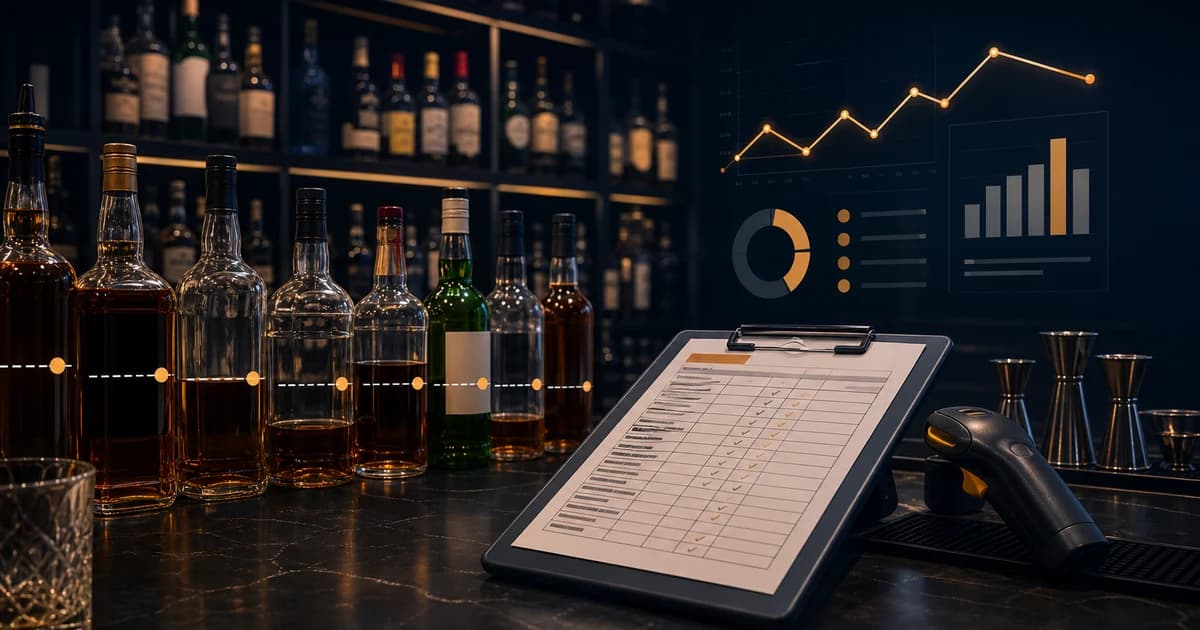
A liquor stocktake is the physical count of every bottle, keg, wine bottle, mixer, and bar inventory item on hand at a specific point in time. For a bar owner, the stocktake is not just an accounting chore. It is the moment where the shelf tells the truth. If the POS says the bar should have used four bottles of tequila and the stocktake shows six bottles missing, the difference has to be explained before it becomes a vague profit problem.
The term stocktake is common in pubs and hospitality operations, but the workflow is the same as a bar inventory count: count what you have, confirm what came in, compare against what sold, account for waste and comps, then review variance. The reason to treat liquor stocktake as its own topic is intent. People searching for it usually need a practical count process, not a broad inventory theory lesson.
This guide shows how to run a liquor stocktake that produces useful variance data. It supports, rather than duplicates, the broader bar inventory count and bar inventory checklist articles by focusing on the actual stocktake workflow: timing, shelf order, partial bottles, purchases, waste, reconciliation, and follow-up.
What Is a Liquor Stocktake?
A liquor stocktake is a complete physical inventory count for beverage products. It usually includes spirits, liqueurs, wine, draft beer, bottled beer, canned beer, mixers, syrups, garnish where tracked, batch containers, backbar stock, storage rooms, keg coolers, event stock, and any product that can be sold or used in a drink. The stocktake creates the ending inventory for one period and the beginning inventory for the next.
The clean accounting formula is beginning inventory plus purchases minus ending inventory. That gives cost of goods sold, or COGS. The IRS explains inventory and COGS principles in Publication 334. In bar operations, the same formula becomes powerful when paired with POS sales and recipes. It tells you what actually left the shelves, then lets you compare that number to what should have left based on sales.
When Should a Bar Run a Stocktake?
Most bars should run a focused stocktake weekly. High-volume bars, nightclubs, and operations with known shrinkage problems may count high-value products more often. A full monthly stocktake may be enough for accounting, but it is usually too slow for loss prevention. By the time a monthly count reveals a problem, the staff memory, shift details, and product trail are already stale.
The best time is consistent: before open, after close, or during another quiet window where sales and receiving are not moving inventory while the count is happening. The exact time matters less than the consistency. A Monday morning count can work. A Sunday night count can work. A random count that changes every week will make comparisons harder.
Prepare the Count Before Touching a Bottle
Preparation decides whether the stocktake is clean or chaotic. Build a count list in shelf order, assign storage areas, confirm which products are active, remove duplicates, and make sure the team knows how to estimate partial bottles. If counters have to decide where items belong during the count, the process slows down and errors increase.
- ▸Freeze the count window so sales, receiving, and transfers are not moving during the stocktake.
- ▸Use the same shelf order every cycle: front bar, back bar, coolers, liquor room, storage, event stock.
- ▸Assign one owner for each area and one manager to review exceptions.
- ▸Confirm count units before starting: bottle, ounce, keg, case, can, or tenth.
- ▸Separate full units from partial units so objective counts happen first.
- ▸Keep waste logs, purchase invoices, and transfer notes ready for reconciliation.
Count Full Bottles and Cases First
Full bottles, unopened wine, sealed cases, full cans, and unopened backup stock are the easiest part of the stocktake. Count them first while the team is fresh. Full units are objective, fast, and less likely to create debate. This also gives you a clean baseline before moving into partial-bottle estimation, which requires more judgment.
Do not skip backstock. Many variance issues are not theft or over-pouring. They are missed cases, bottles stored in the wrong area, event stock that was not returned, or products moved to a patio bar without a transfer note. A complete stocktake includes every place product can hide.
Use One Partial-Bottle Method
Partial bottles are where liquor stocktakes drift. One manager estimates in quarters, another in tenths, and a bartender rounds everything up because the bottle looks close enough. Over time, those small differences create artificial variance. Pick one method and train everyone on it.
Tenths are common because they balance speed and accuracy. A bottle that is roughly 70% full is counted as 0.7. A bottle with a little less than half is 0.4. If your system tracks ounces, convert bottle fractions into ounces consistently. The exact method matters less than using it the same way every time. Fake precision is not the goal. Reliable comparison is the goal.
| Bottle level | Tenths count | Why it matters |
|---|---|---|
| Full sealed bottle | 1.0 | Objective count, fastest to verify |
| Three-quarter bottle | 0.7 or 0.8 | Use the same rounding rule each cycle |
| Half bottle | 0.5 | Common partial level with low debate |
| Quarter bottle | 0.2 or 0.3 | Small rounding differences can add up on premium spirits |
| Empty bottle | 0 | Should be removed from count area after recording if needed |
Reconcile Purchases Before Reviewing Variance
A liquor stocktake cannot be trusted if purchases are missing. Every invoice, credit, substitution, short delivery, emergency run, transfer, and returned product should be entered before variance is reviewed. Otherwise the system may flag missing product that actually arrived or product that appears short because a delivery was never recorded.
This is where a clean bar inventory reconciliation process matters. Counts, purchases, waste, transfers, and POS sales need to belong to the same time period. If the stocktake happened Sunday night but Monday morning deliveries were entered into the period, the numbers will not make sense.
Log Waste, Breakage, and Spoilage
Waste belongs in the stocktake workflow because it explains product movement. A broken bottle, spoiled wine, spilled cocktail, draft foam, remade drink, or discarded ingredient consumes inventory. If it is logged, it can be separated from unexplained loss. If it is not logged, it shows up as variance and forces the manager to guess.
Food and beverage safety rules may require discarding products for quality or safety reasons. The FDA publishes the Food Code as a model for food safety standards. From an inventory standpoint, the key is simple: if product is discarded, record the item, amount, reason, date, and shift so cost control and safety practices stay aligned.
Compare Stocktake Results Against POS Sales
The count becomes useful when it is compared against POS sales and recipes. If the POS says you sold 80 old fashioneds, the system should know how much bourbon, bitters, sugar, and garnish those sales should have used. If the stocktake shows much more bourbon disappeared than expected, you have a variance to investigate. That does not automatically mean theft. It means the product moved in a way the records do not explain.
The bar inventory variance guide covers this math in depth. For stocktake purposes, the takeaway is practical: do not stop after entering counts. Run the comparison while the week is still fresh, then investigate the biggest dollar gaps first.
How to Investigate Stocktake Variance
When a stocktake shows variance, work through the same sequence every time. First, check the count. Was the product counted in every location? Was a partial bottle estimated differently than usual? Was a sealed case missed in storage? Second, check purchases and transfers. Did the product arrive during the period? Was it moved to an event bar or another location? Third, check sales and recipes. Did the POS item map to the right product and serving size? Fourth, check waste, comps, and breakage.
Only after those checks should the manager treat the gap as unexplained loss. This order matters because it keeps the process fair. A variance report is a signal, not a verdict. The goal is to find the most likely operational cause and fix it, whether that cause is a counting error, bad recipe, unlogged waste, over-pouring, or theft.
| Variance clue | First thing to check | Likely next action |
|---|---|---|
| One premium spirit short | All storage locations and comp notes | Recount, review shifts, check access controls |
| Several cocktail ingredients short | Recipe mapping and batch prep | Update recipes or retrain build specs |
| Draft item short | Keg count, foam log, serving size | Review tap setup and waste entries |
| Wine by the glass short | Open bottle spoilage and pour size | Check glassware, staff pours, and open dates |
| Whole category off | Purchases and count timing | Reconcile invoices before investigating staff |
Multi-Location and Event Stocktake Controls
Bars with patios, event rooms, banquet bars, mobile stations, or multiple venues need stricter stocktake controls because product moves more often. Every transfer should have a source, destination, date, product, quantity, and person responsible. Without transfer records, one location looks short while another looks long, and the owner wastes time chasing loss that is really undocumented movement.
Event stock is especially risky. Product is pulled quickly, returned late, and counted by different people. Build an event checkout and return process: what left, who took it, what came back sealed, what came back partial, what was sold, and what was wasted. The stocktake should reconcile event product separately before rolling it into the main weekly variance review.
Build a Stocktake Template That Matches the Bar
A generic stocktake template is better than nothing, but the best count sheet matches the physical bar. Shelf order should follow the room. Categories should match how the bar buys, stores, and sells product. Count units should match the way staff actually count. A tequila bottle, wine case, sixth-barrel keg, house syrup, and garnish tray should not be forced into the same unit logic if that makes the count less accurate.
Your template should include item name, category, storage location, count unit, pack size, bottle size, vendor, cost, par level, reorder point, and notes for unusual products. If the count sheet is organized well, stocktake becomes faster every week because the team moves through the same path and sees the same items in the same order.
Train the Team on Why the Stocktake Matters
Stocktake accuracy improves when staff understand why the count matters. If the process feels like paperwork, people rush. If the team understands that a bad count can make an honest bartender look responsible for missing product, the count becomes more serious. Accurate stocktake protects the business, but it also protects the staff from vague accusations based on bad data.
Training does not need to be complicated. Show the team how a missing partial bottle estimate changes variance. Show how unlogged waste makes a product look stolen. Show how a missed case in storage can create a false shortage. When staff see how the numbers move, they are more likely to count carefully and log exceptions during service.
Use Spot Counts Between Full Stocktakes
A weekly full stocktake is the backbone, but spot counts can catch problems sooner. Choose a small group of high-risk items: premium tequila, high-volume vodka, top bourbon, popular liqueurs, open BTG wines, and one or two draft products. Count those items midweek or after high-risk shifts. A spot count is not meant to replace the full stocktake. It is a pressure check when the bar already knows certain products are vulnerable.
Spot counts work best when they are consistent but not fully predictable. If staff know premium tequila is reviewed after late-night weekend shifts, behavior often improves. If variance continues anyway, the owner gets a tighter time window for investigation. That is much more useful than discovering a monthly shortage after four weekends of service have already passed.
Turn Stocktake Findings Into Operating Changes
The final step is action. A stocktake should change something when it finds a pattern. Maybe a recipe needs to be corrected. Maybe a par level is too high. Maybe a vendor substitution should be blocked. Maybe a bottle needs to move to locked storage. Maybe a bartender needs retraining on a pour. Maybe a shift needs closer review. If the same variance appears week after week and nothing changes, the stocktake has become a ritual instead of a control.
Write the action next to the variance while the report is fresh. Assign an owner and a review date. The best stocktake process creates a loop: count, reconcile, investigate, act, and check whether the next count improved. That loop is how bars turn inventory discipline into recovered margin.
Use Technology Without Losing Process Discipline
A scanner or mobile app can make liquor stocktake faster, but technology does not fix a messy process by itself. If items are duplicated, storage areas are skipped, partials are estimated inconsistently, or purchases are missing, the output will still be noisy. The right technology removes friction and reduces transcription errors. The right process makes the numbers meaningful.
For bars considering scan-based counting, the liquor inventory scanner app guide explains where barcode and photo tools help most. They are strongest when paired with a consistent count order and variance review, not used as a shortcut around inventory discipline.
Liquor Stocktake Checklist
- 1Choose a fixed count window and stop inventory movement during the count.
- 2Count every storage location in the same order every cycle.
- 3Count full bottles, cases, kegs, and sealed products first.
- 4Estimate partial bottles using one consistent method.
- 5Enter all purchases, credits, transfers, and receiving adjustments.
- 6Review waste, comps, breakage, spoilage, and shift notes.
- 7Compare actual usage against expected POS recipe usage.
- 8Sort variance by dollar impact and assign follow-up actions.
- 9Update item records, recipes, par levels, or staff training based on findings.
- 10Repeat weekly so patterns are caught before they become monthly surprises.
Common Liquor Stocktake Mistakes
- ▸Counting at different times each week and comparing inconsistent periods.
- ▸Skipping satellite bars, event stock, liquor rooms, or keg coolers.
- ▸Letting different counters estimate partial bottles differently.
- ▸Reviewing total inventory value without item-level variance.
- ▸Using purchases as usage instead of beginning plus purchases minus ending inventory.
- ▸Running counts but waiting days to review the results.
- ▸Ignoring waste and comps when explaining missing product.
- ▸Treating every variance as theft before checking recipes, counts, and receiving.
How BarGuard Makes Stocktake Useful
BarGuard helps turn a liquor stocktake from a count into a management workflow. The system connects inventory counts, purchases, recipes, POS sales, waste, and variance so managers can see what changed and what needs attention. Instead of ending with a spreadsheet full of bottle levels, the stocktake ends with specific products, dollar gaps, and likely next actions.
That is the difference between counting and controlling. Counting tells you what is there. BarGuard helps show what should be there, what is missing, what is explained, and what still needs investigation. For owners who want the broader workflow, the bar inventory app page explains how counts, invoices, POS data, and variance fit together.
The Bottom Line
A liquor stocktake should be consistent, complete, and tied to follow-up. Count at the same time, move through the bar in the same order, estimate partial bottles the same way, reconcile purchases, log waste, and compare results against POS sales. That is how a stocktake catches loss instead of simply recording inventory value.
If your bar already counts inventory but still cannot explain missing product, the issue is probably not effort. It is the connection between counts, sales, purchases, waste, and variance. Fix that connection, and the stocktake becomes one of the most useful profit-control habits in the business.
BarGuard Catches What You Can't See
Connect your POS, count your inventory, and let BarGuard show you exactly where the gaps are, automatically, every week.