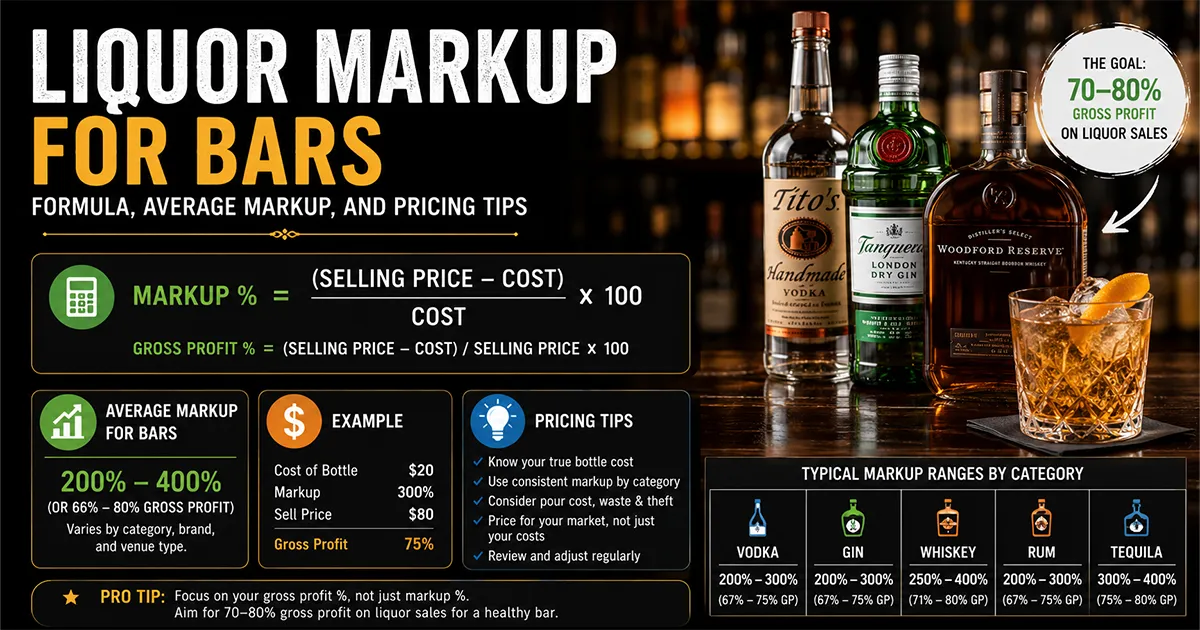
Liquor markup for bars is the difference between what a bar pays for a pour and what the guest pays for the drink. It sounds simple, but markup is where many profitable-looking menus quietly go wrong. If the markup is too low, the bar sells volume without enough gross profit. If it is too high in the wrong place, guests stop buying or trade down. The goal is not the biggest multiplier. The goal is a price that protects margin, fits the concept, and still makes sense to the guest.
Most operators already know they should charge more for liquor than they pay for it. The harder question is how much more. A $24 bottle used in 1.5 oz pours can support one price. A $54 bottle, a premium garnish, a slow cocktail build, a heavy comp culture, and a high-rent room need a different price. If you use one blanket markup across the whole back bar, the numbers may look clean while the menu leaks profit drink by drink.
This guide explains the liquor markup formula, how markup relates to pour cost, what average markup means in a real bar, and how to price liquor without confusing markup, margin, and profit. You will also see examples for shots, neat pours, cocktails, and premium items so you can spot where simple multipliers become misleading.
Pricing also sits inside a real cost environment. The National Restaurant Association's State of the Restaurant Industry research tracks the pressure restaurants and bars face from labor, food, occupancy, and operating costs. Liquor markup cannot be chosen in isolation. It has to help the whole business survive those costs.
What Is Liquor Markup for Bars?
Liquor markup is how many times the bar marks up its product cost to reach the selling price. If one pour costs the bar $2 and the menu price is $10, the markup is 5x. The bar charged five times the product cost.
That formula is useful because it is fast. If a bartender, manager, or owner knows the cost of one pour, the markup shows whether the price is roughly in line with the bar's target. But markup alone does not tell the whole story. It does not show labor, rent, glassware, garnish, waste, discounts, card fees, music, security, or the time it takes to build the drink. It also assumes the pour was the size the recipe says, which only liquor inventory tracking can confirm.
This is why markup should be treated as a pricing shortcut, not the final answer. It helps you check whether a drink is in the right neighborhood. Then you need pour cost, gross profit dollars, menu role, guest expectations, and sales mix to decide whether the price is actually good.
Liquor Markup vs Pour Cost vs Gross Margin
Liquor markup, pour cost, and gross margin describe the same price from different angles. Confusing them leads to bad decisions. A drink can have a strong markup but weak gross profit dollars. Another drink can have a higher pour cost but still be worth keeping because it sells volume, anchors the menu, or brings in guests who buy other profitable items.
- ▸<strong>Markup</strong> asks: how many times product cost did we charge?
- ▸<strong>Pour cost</strong> asks: what percentage of sales went to product cost?
- ▸<strong>Gross margin</strong> asks: what percentage of the selling price is left after product cost?
- ▸<strong>Gross profit dollars</strong> ask: how many dollars did this drink contribute before labor and overhead?
Here is the relationship. A 5x markup means the product cost is one-fifth of the selling price, so the theoretical pour cost is 20%. A 4x markup means the product cost is one-fourth of the selling price, so the theoretical pour cost is 25%. A 3x markup means the theoretical pour cost is 33.3%.
If a drink costs $2.50 to make and sells for $12.50, pour cost is 20% and markup is 5x. The gross profit dollars are $10.00. That $10.00 is what helps pay for staff, rent, insurance, software, cleaning, glassware, card fees, and owner profit.
The Liquor Markup Formula
The basic liquor markup formula starts with cost per pour. You need the bottle cost, bottle size, and pour size. Once you know the cost of the pour, you can apply a target markup or target pour cost.
- 1Find bottle cost from the current invoice.
- 2Convert bottle size to ounces.
- 3Divide bottle cost by bottle ounces to get cost per ounce.
- 4Multiply cost per ounce by pour size to get product cost per drink.
- 5Multiply product cost by the markup target, or divide product cost by the target pour cost.
Both formulas can produce the same result. If the product cost is $2 and you want a 5x markup, the price is $10. If the product cost is $2 and you want a 20% pour cost, the price is also $10 because $2 divided by 0.20 equals $10.
For quick checks, use the BarGuard pour cost calculator. It helps turn bottle cost, bottle size, and pour size into cost per pour and suggested menu prices without rebuilding the math in a spreadsheet. If your menu includes by-the-glass wine, use the dedicated wine cost calculator for bars guide because wine needs spoilage, open-bottle yield, and pour-size checks that spirits do not.
Liquor Markup Example: A Standard 1.5 oz Pour
Imagine a 750 ml bottle costs $30. A 750 ml bottle contains about 25.36 oz. That means the cost per ounce is $30 divided by 25.36, or about $1.18. A 1.5 oz pour costs about $1.77.
- ▸Bottle cost: $30.00
- ▸Bottle size: 750 ml, about 25.36 oz
- ▸Cost per ounce: $1.18
- ▸Pour size: 1.5 oz
- ▸Product cost per pour: $1.77
If the bar uses a 5x markup, the suggested price is $8.85, usually rounded to $9. If the target pour cost is 20%, the same math suggests $8.85. If the target pour cost is 25%, the suggested price is $7.08, usually rounded to $7 or $7.50 depending on the concept.
This is where concept matters. A neighborhood bar may sell that pour for $8. A cocktail bar may sell it as part of a $13 drink. A club may price the same base spirit differently because speed, service environment, rent, entertainment, and demand are different. The formula gives the floor. The business model sets the final price.
Average Liquor Markup for Bars
There is no single average liquor markup that works for every bar. A practical range for many spirits programs is roughly 4x to 6x product cost before waste, comps, discounts, and variance. That lines up with theoretical pour costs around 16.7% to 25%. Premium cocktails, nightclub bottle service, and high-demand products may sit outside that range, while wine, craft beer, and food-heavy restaurant bars may use different targets.
The danger is treating an average like a rule. If your rent, labor, insurance, entertainment, or glassware costs are high, average markup may not be enough. If your guests are value-sensitive, a high multiplier may hurt volume. If one cocktail uses expensive garnish, specialty ice, and slow prep, the liquor markup may look fine while total drink profit is weak.
- ▸Well liquor often supports a stronger markup because cost is lower and volume is high.
- ▸Call spirits need pricing that matches guest expectations and product cost.
- ▸Premium spirits may need lower percentage markup but higher gross profit dollars.
- ▸Cocktails should be priced from full recipe cost, not just base liquor cost.
- ▸Happy hour and specials need separate math because discounts change pour cost immediately.
If you want a healthier benchmark, look at target pour cost by category and then translate it into markup. A 20% target means 5x. A 25% target means 4x. A 30% target means 3.33x. Once you know the target, pricing decisions become clearer.
Why Markup Alone Can Mislead You
Markup feels clean because it gives one number. But one number can hide a lot. A $1.50 product cost sold for $7.50 has a 5x markup and $6.00 in gross profit. A $7.00 product cost sold for $21.00 has only a 3x markup but $14.00 in gross profit. Which one is better? It depends on volume, labor, positioning, and what else the guest buys.
This is why owners should review gross profit dollars next to markup. A lower multiplier on a premium neat pour may still be profitable because it contributes more dollars per transaction. A high multiplier on a cheap well drink may look good but fail to cover labor and overhead if the selling price is too low.
Markup also ignores shrinkage. If the menu assumes a 1.5 oz pour but bartenders average 1.75 oz, the actual product cost is higher than the pricing sheet says. If comps and remakes are not logged, the price may look correct while real pour cost drifts upward. That is where markup has to connect to variance and inventory review.
How to Price Cocktails With Liquor Markup
Cocktails need more than liquor markup because the cost includes every ingredient. Base spirits matter, but so do modifiers, bitters, syrups, juices, garnishes, batch loss, and waste. If you only mark up the liquor portion, the drink may be underpriced before it ever hits the menu.
The clean workflow is to cost the full recipe first. Add the cost of each ingredient, then divide by the target pour cost. That gives a suggested menu price. From there, adjust for market, concept, perceived value, and menu psychology. For the detailed recipe workflow, use the cocktail recipe costing guide and the cocktail pricing formula.
Example: a margarita costs $2.65 to build after tequila, orange liqueur, lime, agave, salt, and garnish. At a 22% target pour cost, the suggested price is $12.05. Rounding to $12 keeps it close. Pricing it at $10 pushes theoretical pour cost to 26.5% before waste. Pricing it at $14 lowers theoretical pour cost to about 18.9%, but the market has to support that price.
Liquor Markup for Premium Bottles
Premium bottles require judgment. A rigid 5x markup can make some high-end spirits look absurdly expensive and slow sales. A lower multiplier may be appropriate if the drink still produces strong gross profit dollars and fits the bar's positioning. The mistake is lowering markup without checking the dollar contribution.
For example, a premium spirit that costs $6 per pour and sells for $18 has a 3x markup and $12 gross profit. A well spirit that costs $1.25 and sells for $7 has a 5.6x markup but $5.75 gross profit. The well drink wins on multiplier. The premium pour wins on dollars. A good menu needs both kinds of thinking.
Premium pricing should also account for slower movement. If the bottle moves slowly, cash sits on the shelf. If the product is allocated, hard to replace, or used in limited cocktails, the price should reflect replacement risk and guest demand. Markup is part of the decision, not the whole decision.
Pricing Mistakes That Shrink Liquor Profit
- ▸Using old invoice costs after vendors raise prices.
- ▸Applying the same markup to every bottle regardless of product role.
- ▸Pricing cocktails from liquor cost only and ignoring mixers, garnish, and waste.
- ▸Copying nearby bars without knowing their costs or margins.
- ▸Discounting happy hour without recalculating pour cost.
- ▸Rounding down too often because the price feels cleaner.
- ▸Ignoring comps, voids, remakes, and over-pouring when checking actual results.
The common thread is stale data. The menu price may have been correct when the drink launched, but costs, recipes, portions, and sales mix change. A quarterly menu review catches some of that. A weekly variance review catches the operational side faster.
How to Review Liquor Markup Every Month
A monthly liquor markup review does not need to be complicated. Start with the drinks and products that move the most dollars. A slow bottle with a bad price matters less than a top seller that is underpriced by a dollar. Rank by sales volume, gross profit dollars, and variance risk.
- 1Update bottle costs from current invoices.
- 2Recalculate cost per ounce for key spirits.
- 3Check top-selling cocktails against current recipe cost.
- 4Compare suggested price against actual menu price.
- 5Review happy hour, discounts, comps, and voids.
- 6Compare theoretical pour cost against actual pour cost.
- 7Flag any drink with low gross profit dollars or repeated inventory variance.
The best review combines pricing and usage. If a drink is underpriced but usage is clean, adjust the price or recipe. If the price is fine but actual usage is high, investigate over-pouring, waste, comp logging, recipe mapping, or theft. The fix depends on the cause.
When to Reprice Liquor and Cocktails
The worst time to reprice is when the bar is already frustrated by a bad month. At that point, the team is usually reacting to symptoms instead of reviewing clean data. A better rhythm is to check prices on a schedule and reprice when a clear trigger appears: vendor cost increases, recipe changes, garnish changes, portion changes, sales mix shifts, repeated variance, or a promotion that changes the effective selling price.
Small changes matter. If a high-volume bottle rises by $3 per case and the menu never moves, the margin loss repeats every shift. If lime cost jumps, a margarita recipe may need a price review even when tequila cost stays flat. If bartenders move from a measured 1.5 oz pour to a casual heavy pour, the menu price did not change but the real markup did. The price sheet and the bar rail have to agree.
Do not reprice everything at once unless the menu is badly out of date. Start with the top sellers, highest-cost pours, and drinks with the weakest gross profit dollars. Then review any product with repeated variance because the pricing problem may not be the posted price at all. It may be missing product, waste, comps, or a recipe that no longer matches how the drink is actually made.
How BarGuard Helps With Liquor Markup
BarGuard helps operators connect pricing math to actual inventory behavior. Pricing sheets show what should happen. Counts, purchases, POS sales, recipes, waste, and variance show what did happen. When those pieces are connected, the owner can see whether a margin problem came from price, recipe cost, supplier cost, over-pouring, waste, or missing product.
Use BarGuard's bar profit tracking, inventory counts, purchase scanning, recipe mapping, and variance reporting to compare theoretical margins against actual usage. That is the difference between setting prices once and actively protecting profit every week.
The Bottom Line
Liquor markup for bars is useful, but it is not magic. A 5x markup can be healthy, too low, or too high depending on the product, recipe, concept, and actual usage. The right price starts with current cost, target pour cost, and gross profit dollars. Then it gets checked against real inventory movement.
If you are pricing by habit, start with your top sellers. Update bottle costs, calculate cost per pour, compare markup to target pour cost, and check whether actual inventory usage matches what the recipe expects. That simple rhythm will protect more margin than copying competitor prices or guessing what guests will tolerate. See markup next to pour cost, beverage cost, and margin in the bar cost calculator and formulas hub.
Frequently Asked Questions
What is a typical liquor markup for bars?
Most bars mark liquor up about 4 to 6 times cost, which works out to a pour cost near 17 to 25%. Well liquor usually carries the highest markup, while premium bottles carry a lower multiple because guests already know the price.
What is the difference between markup and pour cost?
Markup is how many times cost you charge. Pour cost is the inverse, the cost as a percentage of menu price. A 5 times markup is the same as a 20% pour cost. Set targets in pour cost and use markup as the shortcut at the well.
How do you price a cocktail using markup?
Add the cost of every ingredient, including garnish and a small waste allowance, then apply your target markup. A drink that costs $2.40 to make lands near a $12 menu price at a 5 times markup.
Should every spirit use the same markup?
No. Well and rail liquor can take a higher multiple, while premium and call brands take a lower one because guests anchor to the bottle price. Markup should follow the category, not one flat rule.
BarGuard Catches What You Can't See
Connect your POS, count your inventory, and let BarGuard show you exactly where the gaps are, automatically, every week.