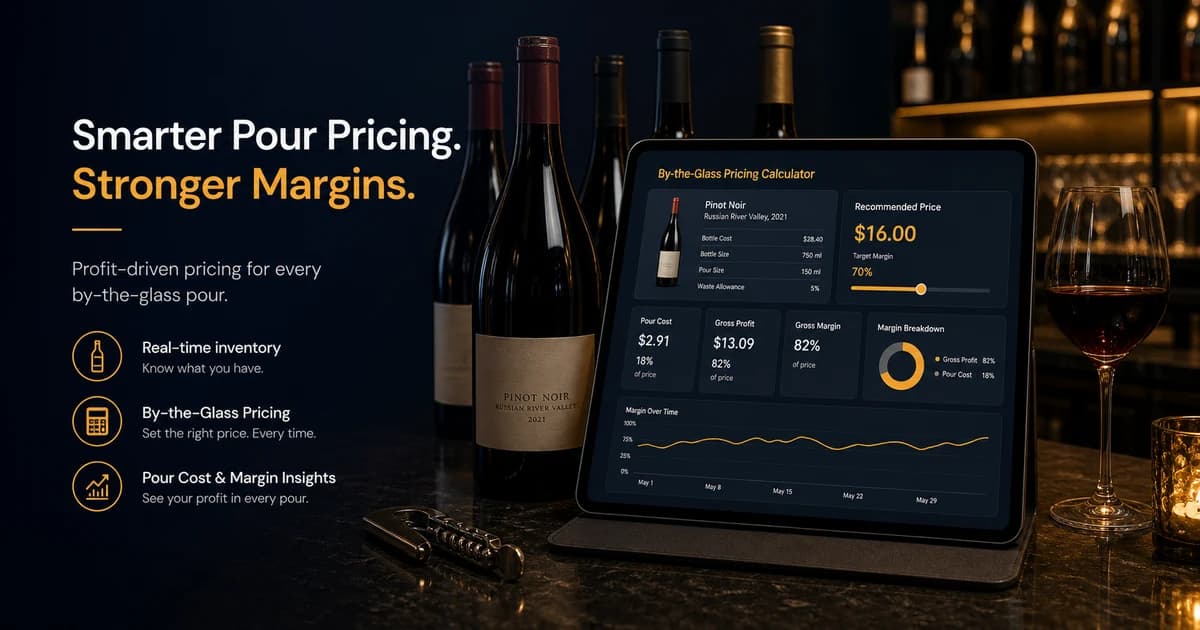
A wine cost calculator for bars should do more than divide a bottle price by five pours. That shortcut is useful for quick math, but it misses the details that quietly damage wine margins: pour size drift, opened bottles that expire before they sell, staff tastes, comps, broken corks, vendor price changes, and by-the-glass prices that never get updated after invoices move. If wine is part of your beverage program, the calculator has to connect bottle cost, serving size, selling price, waste, and actual inventory usage.
This guide shows the full bar-level workflow. You will learn the core formula, how to price a five-ounce or six-ounce glass, how to check bottle and glass margins, how to account for spoilage, and when a wine price that looks profitable on paper is actually leaking money in service. If you want fast bottle math while reading, open the BarGuard pour cost calculator in another tab and use this article as the operating playbook around it.
Wine Cost Calculator Formula for Bars
The basic wine cost calculator formula is simple: bottle cost divided by usable ounces equals cost per ounce. Cost per ounce multiplied by pour size equals cost per glass. Cost per glass divided by target pour cost equals suggested menu price. That sequence gives you a starting price for wine by the glass, but the key word is starting. A bar still has to check market price, perceived value, spoilage risk, and actual sales velocity before locking the number into the menu.
| Calculation | Formula | Example |
|---|---|---|
| Cost per ounce | Bottle cost / bottle ounces | $16 bottle / 25.36 oz = $0.63 per oz |
| Cost per glass | Cost per ounce x pour size | $0.63 x 5 oz = $3.15 per glass |
| Menu price | Cost per glass / target pour cost | $3.15 / 30% = $10.50 suggested price |
| Gross profit per glass | Menu price - cost per glass | $11 price - $3.15 cost = $7.85 gross profit |
| Bottle revenue | Number of pours x menu price | 5 glasses x $11 = $55 bottle revenue |
For accounting, this math ultimately feeds into cost of goods sold. The IRS explains the inventory foundation in Publication 334: beginning inventory plus purchases minus ending inventory is the basic structure behind COGS. Your wine calculator is the operational layer on top of that accounting math. It tells managers whether each glass price supports the COGS target before the monthly financials tell you the margin is already gone.
Start With Bottle Size, Not Guesswork
Most still wine sold by the bottle in bars and restaurants is priced around a 750 ml bottle. For practical calculator work, 750 ml equals about 25.36 fluid ounces. A five-ounce glass gives you just over five pours per bottle. A six-ounce glass gives you a little over four pours. Those fractions matter because the last partial pour often becomes a taste, a comp, or waste unless the bar has a clear standard.
Official alcohol container and labeling rules live under federal alcohol regulations, including wine container standards in the Electronic Code of Federal Regulations. You do not need a regulatory deep dive to price a glass of cabernet, but you do need the discipline of building your calculator from measured bottle volume instead of a rough memory of how many glasses came out last Friday.
| Pour size | Approx. glasses per 750 ml bottle | What it means operationally |
|---|---|---|
| 4 oz | 6.34 pours | Useful for flights, tastings, and premium pours where margin protection matters. |
| 5 oz | 5.07 pours | Common by-the-glass standard and the cleanest baseline for many wine programs. |
| 6 oz | 4.23 pours | Feels generous, but raises cost per glass and leaves less room for error. |
| 8 oz | 3.17 pours | Works for large-format or casual concepts only if price and spoilage controls are strong. |
This is where many bars accidentally underprice wine. A manager thinks a bottle will produce five glasses, but the bartender pours closer to six ounces. On a $16 bottle, the theoretical five-ounce glass costs about $3.15. A six-ounce glass costs about $3.79. That $0.64 difference does not sound dramatic until the bar sells hundreds of glasses a month and never adjusts the menu price.
How to Price Wine by the Glass
To price wine by the glass, choose a target pour cost, calculate the exact cost of your standard pour, then divide the cost by the target. If the bar wants a 30% pour cost and the glass costs $3.15 to pour, the suggested price is $10.50. Most menus would round that to $11, then check whether the guest perception supports the price. This is the same logic behind the broader liquor markup formula, but wine needs its own lens because spoilage and open-bottle velocity matter more.
A healthy target depends on the concept. A neighborhood bar might run some approachable wines at a higher pour cost because the list is simple and guests are price sensitive. A cocktail bar with a small curated wine list may need stronger margin on every glass because the volume is lower. A wine bar can carry deeper inventory, but it also has to watch open-bottle age, staff education pours, and slow movers more carefully. The calculator should show the number; the manager still has to decide whether the number fits the venue.
| Bottle cost | 5 oz glass cost | Price at 35% cost | Price at 30% cost | Price at 25% cost |
|---|---|---|---|---|
| $10 | $1.97 | $5.63 | $6.57 | $7.88 |
| $14 | $2.76 | $7.89 | $9.20 | $11.04 |
| $18 | $3.55 | $10.14 | $11.83 | $14.20 |
| $24 | $4.73 | $13.51 | $15.78 | $18.92 |
| $32 | $6.31 | $18.03 | $21.03 | $25.24 |
The table explains why by-the-glass lists usually need tiers. A $10 landed-cost bottle can support a $7 or $8 glass. A $32 bottle may need a $21 glass at a 30% target, which may or may not fit your concept. That does not mean you cannot pour the higher-cost bottle by the glass. It means you need a reason: strong demand, a premium guest experience, a smaller pour, a higher menu price, or a feature placement that moves the bottle quickly.
Add Spoilage Before You Trust the Margin
Wine is different from spirits because an opened bottle has a shorter useful life. Spirits can sit after opening with far less operational pressure. Wine starts a clock. If the fifth glass never sells, the four glasses that did sell have to carry the cost of the whole bottle. That is why a wine cost calculator for bars should include a spoilage adjustment, especially for slower-moving by-the-glass selections.
A simple way to adjust is to estimate the average usable pours per opened bottle. If your standard is five pours but you usually sell only four before dumping the last pour, price the wine as a four-pour bottle. The glass cost on a $16 bottle changes from $3.15 at five pours to $4.00 at four pours. At a 30% target, that moves the suggested price from about $10.50 to $13.33. That is not a rounding issue. That is the difference between a profitable glass and a menu item that looked healthy only because the calculator ignored waste.
Spoilage is also why your bar waste log matters. Dumped wine should not disappear into vague end-of-night memory. It should be logged by product, quantity, reason, shift, and cost. Once waste is recorded, the bar can separate a pricing problem from an ordering problem. Maybe the glass price is fine, but the bar opens too many bottles at once. Maybe the ordering par is too high. Maybe staff are using premium wine for tastes without recording it. The math will not explain the cause unless the operation records what happened.
The Wine Cost Calculator Workflow
Use this workflow whenever you add a wine, review vendor prices, or rebuild the by-the-glass list. It keeps the calculation practical enough for managers to use while still catching the margin details that get lost in a simple spreadsheet.
- 1Enter the landed bottle cost, including the current invoice price after credits, delivery charges, or case discounts that affect real cost.
- 2Enter the bottle size and standard pour size so the calculator can estimate cost per glass from measured volume.
- 3Choose a target pour cost for the wine category, usually different from spirits, draft beer, and cocktails.
- 4Calculate suggested glass price and bottle revenue before rounding.
- 5Adjust for spoilage by reducing the expected usable pours if the wine is slow-moving or frequently dumped.
- 6Compare the suggested price with nearby menu items so the wine list feels intentional instead of randomly priced.
- 7Record the final price, then review actual usage against POS sales after the wine has been live for a few weeks.
That last step is the one most bars skip. The calculator gives a theoretical price. Inventory tells you whether theory survived service. If POS sales say you sold twenty glasses of sauvignon blanc, your recipe says each glass is five ounces, and your count shows far more depletion than expected, the problem is not the formula. The problem is pour control, waste, comps, incorrect bottle counts, or staff using that wine in a cocktail or spritz without mapping it. The bar inventory variance guide explains how to investigate that gap without guessing.
Bottle Pricing Still Needs a Calculator
By-the-bottle pricing is easier operationally because spoilage risk shifts after the guest buys the bottle. But bottle pricing still needs discipline. Many bars use a simple multiplier, such as two times or three times cost. That can work as a rough screen, but it breaks down when low-cost bottles become overpriced or high-cost bottles become impossible to sell. A smarter approach is to use a margin floor, a market check, and a tiered markup structure.
| Bottle cost tier | Common pricing approach | Risk to watch |
|---|---|---|
| $8-$14 | Higher markup can still feel affordable | Do not turn entry wines into bad value. |
| $15-$25 | Balanced markup with clear menu positioning | Review invoice changes often because volume is usually higher. |
| $26-$45 | Lower multiplier but strong gross profit dollars | Price must match guest expectations for the concept. |
| $46+ | Margin dollars matter more than strict percentage | Slow movement can tie up cash and crowd the cellar. |
A $12 bottle sold for $36 produces $24 of gross profit before labor and overhead. A $50 bottle sold for $100 produces $50 of gross profit even though the percentage margin is lower. That is why wine programs should not chase one universal markup across every bottle. The goal is profitable movement. If a high-end bottle sits for months, the theoretical margin is not helping cash flow. If a lower-cost bottle moves quickly but is underpriced by $2 per glass, the bar gives away profit every service.
Do Not Price Wine in Isolation
Wine pricing touches the rest of the menu. If cocktails have stronger perceived value, guests may ignore a wine glass that feels expensive. If draft beer is priced aggressively, casual guests may trade down. If the food menu has pairings, certain wines may deserve lower margins because they help sell higher-margin dishes. The wine cost calculator should not replace judgment. It should make the tradeoffs visible so ownership knows what it is choosing.
This is also where wine connects to broader bar profitability. Our guide to bar profit margin covers the larger relationship between revenue, COGS, labor, rent, and operating profit. Wine is only one category, but it can pull the whole beverage margin down if open bottles are poorly controlled. A category that looks small on the sales mix can still create a big loss when premium bottles are wasted or poured heavy.
If wine is used in cocktails, spritzes, sangria, batches, or kitchen prep, it should also be mapped into recipes. The cocktail recipe costing workflow applies here because the bottle cost needs to flow into every item that uses that wine. A glass pour, a sangria batch, and a spritz special cannot all pull from inventory without recipe mapping and still produce trustworthy variance.
Common Wine Pricing Mistakes
The most common mistake is pricing from memory instead of current invoices. A wine that cost $13 last quarter may cost $15 now. If the menu price stays fixed, the pour cost rises automatically. The second mistake is assuming every bottle produces the planned number of glasses. Heavy pours, staff tastes, and partial dumps reduce usable yield. The third mistake is treating comps as hospitality without cost. Hospitality has a cost, and it should be visible.
- ▸Using five pours per bottle when the team actually pours closer to six ounces.
- ▸Leaving glass prices unchanged after vendor costs increase.
- ▸Opening too many by-the-glass bottles at the same time during slow periods.
- ▸Not logging dumped wine, staff tastes, training pours, or guest comps.
- ▸Pricing bottle and glass lists with the same markup logic.
- ▸Letting slow-moving premium bottles occupy cash and cooler space without review.
- ▸Forgetting that wine used in cocktails or batches must be recipe-costed too.
None of these mistakes are dramatic on one shift. That is why they survive. A few ounces dumped, one extra taste, one heavy pour, one invoice increase, and one unchanged menu price do not feel like a crisis. Together, they create the exact kind of margin drift that makes owners wonder why beverage sales look healthy but cash feels tight.
Use Inventory Data to Check the Calculator
The strongest wine cost calculator is not a standalone sheet. It is connected to actual inventory behavior. After each count, the bar should compare expected wine usage from POS sales against actual depletion from inventory. If the numbers match, the price and pour standards are probably working. If actual depletion is higher, the bar needs to investigate before the next ordering cycle hides the pattern.
BarGuard is built for that connected workflow. The BarGuard features tie together inventory counts, purchase scanning, POS sales, recipe costs, waste logs, and variance reporting so a manager can see whether wine margin is being lost to price, waste, over-pouring, or data entry. The pricing calculator gives the target. The inventory system tells you whether the bar actually hit it.
| Signal | Likely issue | Next action |
|---|---|---|
| Glass sales are strong but margin is weak | Menu price or vendor cost changed | Recalculate using current invoices and target pour cost. |
| Actual depletion is above expected usage | Heavy pours, unlogged waste, comps, or recipe gaps | Review variance by product and compare against waste logs. |
| Opened bottles are frequently dumped | Too many BTG options or low velocity | Reduce open selections, rotate features, or adjust par levels. |
| Bottle sales are slow but inventory value is high | Cash tied up in slow movers | Review list depth and reorder points. |
| Wine appears in cocktails but not recipe costs | Understated cocktail cost | Map wine into every recipe that uses it. |
How Often Should Bars Recalculate Wine Cost?
Recalculate wine cost any time the invoice price changes, the pour size changes, the menu price changes, or the wine moves from bottle-only to by-the-glass. At minimum, review the by-the-glass list monthly and the bottle list quarterly. Faster-moving wines deserve more frequent checks because small price errors multiply quickly. Slow-moving wines deserve review because spoilage and cash tie-up can be larger than the manager expects.
This review should sit next to purchasing and par level decisions. If a by-the-glass wine sells quickly and rarely gets dumped, par may need to increase. If a bottle is constantly dumped after one or two glasses, the problem may be selection, menu placement, staff recommendation, or too many open alternatives. The bar par levels guide explains how to set reorder points from actual usage instead of gut feel.
Food Safety and Perishable Bar Ingredients
Wine pricing is mostly a margin problem, but bars also need clean handling standards around perishable mixers, juices, garnishes, and prepared batches that may sit near the wine station. The FDA Food Code is the source operators and local regulators commonly look to for food safety principles. Do not use margin pressure as a reason to stretch questionable perishable products. If something should be discarded, log it as waste and let the data inform better prep, ordering, or menu decisions.
The same principle applies to oxidized wine. If a glass no longer represents the product well, selling it to protect cost can damage guest trust. The answer is not to pour bad wine. The answer is to control the number of open bottles, train staff on preservation standards, and track dumped product honestly so the cost shows up where management can fix it.
A Practical Example
Say your bar buys a pinot grigio for $15 per bottle. You pour five ounces per glass and want a 30% pour cost. A 750 ml bottle gives about 25.36 ounces, so cost per ounce is roughly $0.59. A five-ounce pour costs about $2.96. Divide $2.96 by 0.30 and the suggested price is $9.87, which you might round to $10. If the wine sells reliably and almost every opened bottle is finished, that price can work.
Now change one assumption. The team pours six ounces because the glassware makes five ounces look light. The cost per glass becomes about $3.55, and the $10 menu price creates a 35.5% pour cost. Change another assumption: the last glass gets dumped on slow weeknights. Now the four glasses that sold have to cover the $15 bottle, making the true cost per sold glass $3.75 before any comps or tastes. Suddenly the wine that looked acceptable is running closer to a problem.
That is why a good calculator has to be operational, not just mathematical. The arithmetic was correct in the first version. The assumptions were wrong. Bar managers should price wine using the planned standard, then validate that standard with counts, sales, and waste logs. When reality differs from the plan, update the plan.
Wine Cost Calculator Checklist
- ▸Use the current invoice cost, not last month's remembered bottle cost.
- ▸Confirm bottle size and standard pour size before calculating cost per glass.
- ▸Choose a category-specific wine pour cost target instead of copying liquor targets.
- ▸Adjust slow-moving by-the-glass wines for dumped ounces and staff tastes.
- ▸Review glassware because oversized glasses encourage heavy pours.
- ▸Map wine used in cocktails, spritzes, sangria, and batches into recipe costs.
- ▸Compare expected usage from POS sales against actual usage from inventory counts.
- ▸Update menu prices when vendor cost, pour size, or spoilage patterns change.
If you only take one habit from this guide, make it this: every wine price should have a current cost, a standard pour, a target margin, and an inventory check behind it. When one of those four pieces is missing, the bar is no longer pricing. It is hoping.
Where BarGuard Fits
BarGuard helps bars protect wine margin by connecting the calculator work to the rest of the operation. You can scan purchases, keep bottle costs current, map recipes, count inventory, log waste, and compare actual depletion against POS sales. That means wine pricing is not trapped in a spreadsheet that nobody checks after the menu is printed. It becomes part of the weekly profit review.
If you are tightening your beverage program, start with the calculator, then connect it to your real usage. Use the pour cost calculator for quick price checks, review how to price cocktails for menu logic, and use BarGuard profit tracking to see whether the numbers hold up after service. That is how wine pricing moves from a one-time menu task to a repeatable margin control system. For the full set of bar cost tools in one place, see the bar cost calculator and formulas hub.
BarGuard Catches What You Can't See
Connect your POS, count your inventory, and let BarGuard show you exactly where the gaps are, automatically, every week.
Frequently Asked Questions
What is a good pour cost for wine by the glass?
Many bars use a target range around 28% to 35% for wine by the glass, then adjust based on concept, price sensitivity, spoilage risk, and sales velocity. The target should be checked against actual inventory usage, not just theoretical recipe math.
How many five-ounce glasses are in a 750 ml bottle of wine?
A 750 ml bottle contains about 25.36 fluid ounces, so it provides just over five five-ounce pours before accounting for sediment, tasting pours, spills, or dumped product.
Should a wine cost calculator include waste?
Yes. If opened bottles are often dumped before the final pour sells, the calculator should reduce expected usable pours or add a spoilage adjustment. Otherwise the menu price may look profitable while actual margin is weak.
Is bottle pricing the same as by-the-glass pricing?
No. Bottle pricing usually has less spoilage risk after purchase, while by-the-glass pricing has to account for open-bottle waste, heavy pours, staff tastes, and comps. Both need margin checks, but the risk profile is different.