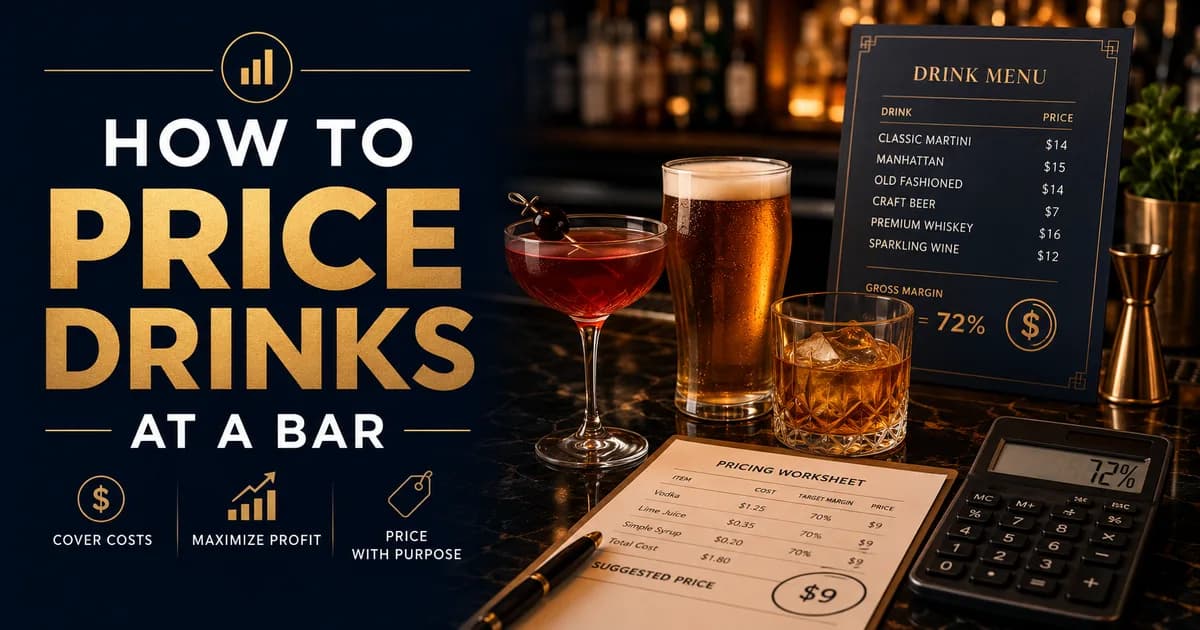
Pricing is where bars win or lose their margin, and most owners set prices by looking at what the bar down the street charges. Matching the competition is a starting point, not a strategy. The bars that make money price every drink from cost up, then adjust for what the market will bear. This guide shows how to price drinks at a bar the right way: from pour cost to markup to a menu that actually protects profit.
This is the pricing hub. It ties together the deeper guides on pour cost, liquor markup, cocktail pricing, wine by the glass, and happy hour pricing. If you want one mental model for setting every price on the menu, start here.
Start With Cost, Not the Competition
Every solid drink price starts with one number: what the liquor, beer, or wine in that drink actually costs you to pour. If you do not know your cost per pour, you are guessing, and guessing favors the customer, not the bar. Competitor prices matter as a ceiling and a sanity check, but they should never be the foundation. The bar across the street may have a different rent, different volume, and a different cost structure. Copying their price copies their margin, not yours.
The right order is always: calculate cost, apply your target markup or pour cost, then adjust toward the market and your positioning. That sequence keeps you profitable even when a distributor raises prices, because your pricing is anchored to your own numbers.
Pour Cost: The Foundation of Every Price
Pour cost is the percentage of a drink's price that goes to the product in it. If a drink costs you 2 dollars to pour and you sell it for 10 dollars, your pour cost is 20 percent. Most bars target somewhere around 18 to 22 percent on liquor, which leaves healthy room for labor, rent, and profit. The full method, including how to fix a number that is running high, is in the pour cost guide.
| Step | Example | Result |
|---|---|---|
| Cost per pour | Bottle costs $24, holds about 25 pours | $0.96 per pour |
| Target pour cost | Aim for 20% pour cost | Divide cost by 0.20 |
| Base price | $0.96 divided by 0.20 | $4.80 pour cost floor |
| Menu price | Round up and adjust for market | $6 to $8 depending on concept |
Markup: The Other Side of the Same Coin
Pour cost and markup are two views of the same math. Pour cost asks what percentage of the price is product. Markup asks how many times cost you charge. A 20 percent pour cost is the same as a 5 times markup. Some owners think in markup multiples because it is faster at the bar: cost times five, round to a clean price. The liquor markup guide covers how to set multiples by category so well drinks, call drinks, and premium pours each carry the right margin.
Use whichever framing you find easier, but be consistent. Mixing methods across the menu is how some drinks end up underpriced. Pick a target pour cost or a markup multiple per category and apply it the same way every time.
Pricing by Drink Type
Different categories need different pricing logic because their cost behavior is different. A single target does not fit liquor, cocktails, beer, and wine equally.
Liquor and Well Drinks
Single-spirit drinks are the easiest to price. Calculate cost per pour, apply your target pour cost, and round to a clean menu number. Keep well, call, and premium tiers clearly separated so customers trade up and each tier protects its margin.
Cocktails
Cocktails have multiple ingredients, so you have to cost the full recipe, not just the base spirit. Modifiers, juices, syrups, garnishes, and labor all add up. Price from the total recipe cost, and account for the time-intensive builds that tie up a bartender. The cocktail pricing guide walks through recipe costing in detail.
Beer
Bottles and cans are simple cost-plus. Draft is trickier because foam, line cleaning, and over-pouring all create loss that raises your true cost per pint. Price draft with that shrinkage in mind so the keg actually delivers the margin you expect.
Wine by the Glass
Wine by the glass depends entirely on how many glasses you get from a bottle and how disciplined the pour is. An over-poured glass destroys the margin fast. Pricing wine by the glass has its own method, covered in the wine by the glass guide.
Build a Menu That Protects Margin
Individual prices are only half the job. The menu as a whole should steer customers toward profitable choices and make trading up feel natural. A few principles go a long way:
- ▸Anchor with a premium option so mid-tier prices feel reasonable by comparison.
- ▸Keep price tiers clear so guests can trade up without feeling nickel-and-dimed.
- ▸Feature high-margin signature drinks where the eye lands first.
- ▸Avoid lining up prices in a column that invites guests to shop the cheapest option.
- ▸Round to clean, confident numbers rather than awkward odd cents.
Reprice on a Schedule, Not by Accident
The most common pricing mistake is setting prices once and never revisiting them. Vendor costs rise steadily, but menu prices tend to sit still until an owner finally notices the margin has eroded. By then the bar has been selling drinks at the wrong price for months. Build repricing into your routine so cost increases never quietly eat your profit.
Tie repricing to your inventory and cost reviews. When you count regularly and track cost per pour, a rising vendor price shows up immediately, and you can adjust before it damages margin. Accurate inventory is what makes proactive pricing possible. The cost control approach and a steady count habit keep your prices honest.
How to Price a Drink: Step by Step
- 1Find the cost per pour or full recipe cost for the drink.
- 2Choose your target pour cost or markup multiple for that category.
- 3Calculate the base price from cost and target.
- 4Adjust toward the market and your concept positioning.
- 5Round to a clean, confident menu number.
- 6Recheck the price whenever vendor cost changes or on a set schedule.
Frequently Asked Questions
How do you price drinks at a bar?
Start from cost. Calculate the cost per pour or full recipe cost, apply your target pour cost or markup multiple, then adjust toward the market and round to a clean number. Pricing from cost protects your margin even when vendor prices rise.
What is a good pour cost for a bar?
Most bars target around 18 to 22 percent pour cost on liquor. A 20 percent pour cost is the same as a 5 times markup. Cocktails, draft beer, and wine by the glass each need their own target because their cost behavior differs.
How much should I mark up liquor?
A common starting point is roughly 4 to 6 times cost depending on the tier and your market, which lines up with a pour cost in the high teens to low twenties. Set the multiple by category so well, call, and premium drinks each carry the right margin.
How often should I change drink prices?
Review prices whenever vendor costs change and on a regular schedule at minimum. Prices that sit still while costs rise quietly erode your margin, so tie repricing to your inventory and cost reviews.
The Bottom Line
Pricing drinks well is not about matching the bar next door. It is about building every price from your real cost, applying a consistent target, and shaping a menu that steers guests toward profit. Do that, and revise it as costs move, and your pricing protects margin instead of leaking it.
Use this hub to set your overall approach, then go deep on the pieces that matter most for your bar: pour cost, markup, cocktails, and wine by the glass. Tight pricing is one of the fastest paths to a healthier bottom line.
BarGuard Catches What You Can't See
Connect your POS, count your inventory, and let BarGuard show you exactly where the gaps are, automatically, every week.