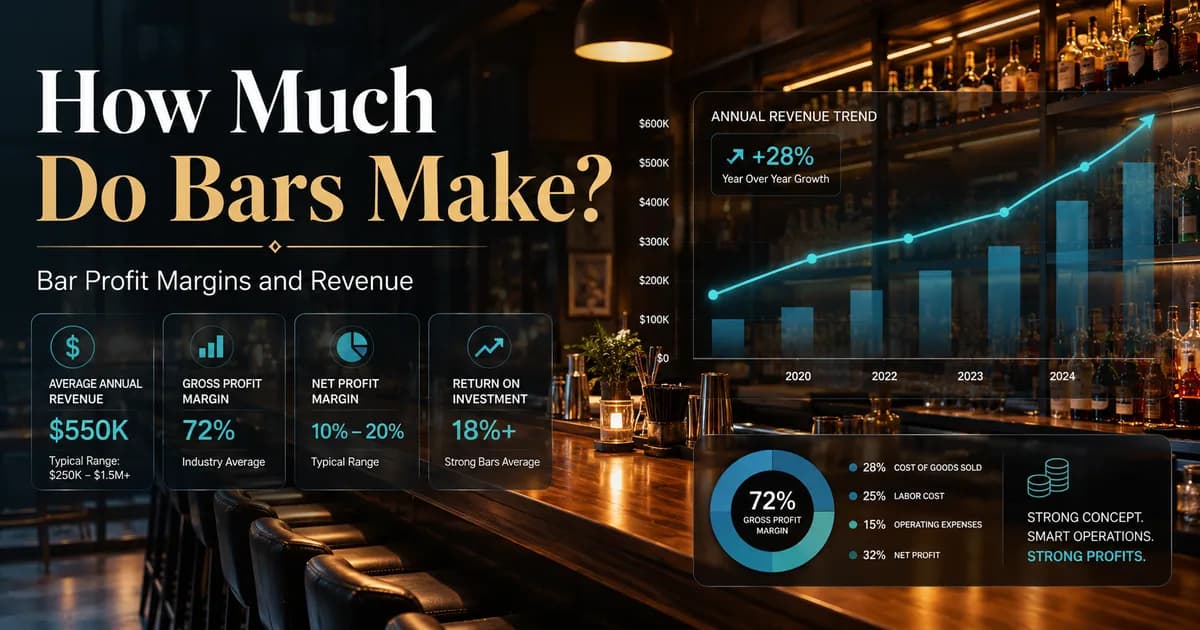
How much do bars make? The honest answer is that most bars keep somewhere between 0 and 15 percent of revenue as net profit, and the difference between a bar that nets 2 percent and one that nets 12 percent is almost always cost control, not sales volume. Two bars can ring the same sales and end the year in completely different places. One owner takes home a real living. The other works seventy hours a week to break even.
This guide breaks down what a bar actually makes: the revenue it brings in, the costs that eat that revenue, the profit that is left, and what the owner can realistically take home. It also shows the levers that decide which side of that range you land on. If you want the metric-level detail on margin, the bar profit margin guide goes deeper, and beverage cost covers the cost side. This post answers the bigger question owners actually ask: is this business worth it, and how much money is in it?
Revenue Is Not Profit
The first mistake owners make is judging the business by the register. A bar can pull strong nightly sales and still end the month with almost nothing left. Revenue is the top line. Profit is what survives after cost of goods, labor, rent, utilities, insurance, licensing, marketing, repairs, and everything else. A bar that does strong sales but pours heavy, wastes product, and overstaffs slow shifts can easily turn a great top line into a thin bottom line.
So when someone asks how much a bar makes, the useful answer is never the sales number alone. It is the margin. A bar doing strong monthly revenue at a 5 percent net margin makes less real money than a smaller bar running a 12 percent margin. The owners who win are the ones who manage the gap between revenue and profit, not just the revenue.
The Bar Profit Formula
Bar profit is simple to write down and hard to protect. Every dollar of revenue passes through the same set of costs before it becomes profit.
| Line | What it is | Direction |
|---|---|---|
| Revenue | All sales: liquor, beer, wine, food, cover, events | Money in |
| Cost of goods sold | What the product in those sales cost you | Subtract |
| Labor | Bartenders, barbacks, servers, management, payroll taxes | Subtract |
| Occupancy | Rent, utilities, insurance, property costs | Subtract |
| Other operating costs | Licensing, marketing, repairs, supplies, fees | Subtract |
| Net profit | What is actually left for the business and owner | Result |
Cost of goods sold is where bars leak the most quietly. The formula is straightforward: beginning inventory plus purchases minus ending inventory equals the cost of what you sold. The IRS explains the inventory and cost of goods sold principle in Publication 334. The hard part is not the math. It is making sure the numbers feeding the formula are accurate, which is exactly where weak inventory control costs owners thousands.
What a Typical Bar Cost Structure Looks Like
Cost structures vary by concept, market, and rent, but most bars cluster in similar ranges. Use these as a sanity check, not a rule. If a category is far above the typical range, that is where your profit is going.
| Cost category | Typical share of revenue | What pushes it out of range |
|---|---|---|
| Beverage cost of goods | 20% to 30% | Over-pouring, waste, theft, weak pricing |
| Labor | 25% to 35% | Overstaffing slow shifts, no scheduling to sales |
| Occupancy | 6% to 10% | High rent relative to sales volume |
| Other operating | 10% to 15% | Fees, repairs, marketing with no return |
| Net profit | 0% to 15% | Whatever the four lines above leave behind |
Notice that beverage cost and labor together usually decide the whole game. They are the two biggest, most controllable lines. A few points of improvement on either one flows straight to profit. That is why disciplined owners obsess over pour cost and scheduling instead of chasing more cover charges.
How Much Do Bar Owners Actually Take Home?
Owner take-home is not the same as net profit. Many small bar owners pay themselves a manager-level wage for the hours they work behind the bar and in the office, then the net profit sits on top of that. In a small owner-operated bar, the owner may earn a modest salary plus whatever profit the business generates. In a larger or multi-location operation, the owner steps back from shifts and lives more on the profit and any distributions.
The realistic picture: a healthy independent bar can pay its working owner a reasonable wage and still produce profit on top, but only when costs are controlled. A poorly run bar pays the owner in stress and unpaid hours. The business can look alive from the outside and still leave nothing for the person who owns it. That is why margin matters more than the door count.
Why Two Bars With the Same Sales Make Different Profit
If you put two bars side by side with identical sales, the more profitable one almost always wins on the same handful of controllable factors:
- ▸Pour discipline. Free pours and heavy hands turn a 20 percent pour cost into 28 percent without anyone noticing.
- ▸Waste. Spills, breakage, foamed-off draft beer, and expired product all leave the building as lost margin.
- ▸Theft and shrinkage. Unrung drinks, over-comps, and missing bottles silently cut into profit.
- ▸Pricing. Menus that have not been repriced against current cost are quietly selling drinks at a loss.
- ▸Purchasing. Buying at the wrong price or the wrong quantity ties up cash and inflates cost.
- ▸Labor scheduling. Staffing slow shifts like busy ones is one of the fastest ways to burn margin.
The Levers That Actually Move Bar Profit
If you want to make more money without simply selling more, pull the controllable levers first. Each one flows directly to the bottom line.
Pour Cost
Pour cost is the percentage of a drink's sale price that goes to the liquor in it. It is the single most important number on the beverage side. A target near 20 percent for liquor is common, and every point above target is profit walking out the door. The how to calculate pour cost guide shows the exact math and how to fix a high number.
Shrinkage and Over-Pouring
Shrinkage is the gap between what you should have sold and what you actually sold based on inventory. The bar shrinkage breakdown shows how fast it adds up, and over-pouring losses covers the most common cause. A single heavy-handed bartender can cost a bar real money over a month.
Pricing and Markup
If your menu prices have not moved while your costs have, your margin is shrinking on autopilot. Reprice against current cost using the liquor markup approach, and tie the full menu together with a clear drink pricing strategy.
Cost Control Systems
Owners who consistently hit strong margins are not guessing. They run the numbers. Bar cost control software and structured inventory turn cost control from a monthly surprise into a weekly habit.
How Inventory Control Protects Bar Profit
Profit lives and dies on accurate inventory because cost of goods sold is calculated from it. If counts are sloppy, the profit number is fiction. Worse, you cannot see where product is disappearing. Structured counts, variance tracking, and POS-connected usage turn invisible losses into a list you can act on. The bar inventory management guide covers the full system, and inventory variance shows how to read the gap between expected and actual.
This is the difference between hoping the bar is profitable and knowing it is. When an owner can see pour cost by category, variance by product, and waste by reason every week, profit stops being a year-end mystery and becomes something they manage on purpose.
A Simple Plan to Make Your Bar More Profitable
- 1Count inventory on a consistent schedule so cost of goods sold is accurate.
- 2Calculate pour cost by category and compare it to your target.
- 3Find the products with the worst variance and investigate pouring, waste, and theft.
- 4Reprice any drinks whose cost has risen since the menu was last set.
- 5Schedule labor to actual sales patterns instead of staffing every shift the same.
- 6Review the numbers weekly so problems surface in days, not at month-end.
Frequently Asked Questions
How much profit does a bar make?
Most bars net somewhere between 0 and 15 percent of revenue. Where a bar lands depends mostly on cost control: pour cost, waste, theft, pricing, and labor. Strong operators sit at the high end, while poorly run bars hover near break-even.
Is owning a bar profitable?
It can be, but profitability is not automatic. A bar with strong sales and weak cost control can lose money, while a disciplined operation with modest sales can pay its owner well. The deciding factor is managing the gap between revenue and profit.
What is a good profit margin for a bar?
A net profit margin in the high single digits to low teens is healthy for most bars. If your margin is near zero, the problem is usually a cost line running hot rather than a lack of sales.
How much do bar owners make?
In a small owner-operated bar, the owner often earns a manager-level wage for the hours worked plus whatever net profit the business produces. In larger or multi-location operations, the owner relies more on profit and distributions than on hourly work.
How do I make my bar more profitable?
Start with the controllable levers: accurate inventory, pour cost, variance, pricing, and labor scheduling. Improving beverage cost and labor by even a few points each flows straight to the bottom line.
The Bottom Line
How much a bar makes is not decided at the register. It is decided in the gap between revenue and profit, and that gap is controllable. Pour cost, waste, theft, pricing, and labor are the levers that turn a busy bar into a profitable one. Sales get attention, but margin is what pays the owner.
If you are not sure whether your bar is genuinely profitable, the fastest way to find out is to tighten inventory and cost control so the numbers stop guessing. Once you can see pour cost, variance, and waste clearly, the profit you are leaving on the table becomes obvious, and recoverable.
BarGuard Catches What You Can't See
Connect your POS, count your inventory, and let BarGuard show you exactly where the gaps are, automatically, every week.